I talked with John D yesterday for a bit about publishing, online resources, and the general structure of the scientific literature world, which was interesting since we come from different backgrounds and generations. He emphasized the importance of the different 'levels' of journals, for instance, that Nature Neuroscience papers are generally better than EBR, etc. I think that can be something that gets wrapped in or emerges from an online community (alaDigg, Reddit, etc.).
Well, fresh off my rss of doom (you should have seen the librarians faces when I said, "Yeah, 900 unread items right now. I'll get through that in about 30-45 minutes." Google Brain FTW), is this bit from The Urban Elitist (via Polymeme) on good ole book publishing, which I often forget about. In the wake of the Kindle's success and Google's agreements with universities and now magazines, the author asks how they will remain a viable business.
Books are significantly different from papers in many, many ways, but they share some similar problems. We still have another 30-50 years before a truly paperless society is possible, and current media have a much shorter lifespan that good ole paper and clay tablets (a topic for another day, but I would not be surprised to see a major project get funded for looking into storage devices that last 10's of thousands of years). Books are unidirectional and stylized, while research papers are really made to be discussed. But, books aren't the TV to primary lit's video games because they, too require active participation, and focused attention.
Anyhow, something worth a few minutes of meditating on.
First, I've been messing with the latest Mendeley release, and the performance/speed issues are much improved. Unfortunately, there are several new nasty bugs, which the company is aware of and working on. These problems stem from the complete rewrite of the code that finished just prior to public release (more on this later), so I'd expect them to be in working order very soon (I assume version 0.6.1 will be at the bug-free level of v 0.5.9). The most significant issue is the inability to sync libraries to the server, which will be addressed first. Auto-renaming on Windows (at least) is broken as well, which isn't really a bad thing, since a previous bug could cause trouble for less savvy Windows users - see my post about the file name length issue.
Now, the good/big news is that I got to meet with Victor Henning, one of the two co-founders of Mendeley. Awesome guy, and we ended up talking for about 4 hours about various topics, from research to Mendeley business.
On the topic of the bugs in 0.6.0, Victor mentioned that there were several setbacks in the schedule due to all the non-coding workings which took time from the bug squashing. They promised the new version by the end of November and wanted to deliver on it, which they did, but needed about 2 weeks to work out the new code's kinks. There were some other things, but overall they needed this version out when it was released and getting everything up to the functionality of 0.5.9 is priority #1, and should be a matter of weeks. What's reassuring is that it isn't a case of not knowing what is wrong, or the problems being unexpected. They're on top of it all. Figuring out how to optimize the code and make things run smoother is MUCH more difficult from a coding perspective, so the fact they they addressed that so impressively means the smaller bugs should be cake.
The vision of the program and service, and some of the collaborations (sorry, all hush hush, but the details are very sweet), make me truly excited about the future of the project. The next post will cover some of the similar, but either more unstable or less usable options, and none of them hold a candle to where Mendeley will be in a year, or so. Victor and company are very interested in keeping the system features responsive to users' needs, and the push is far more towards openness and adoption than hoarding and proprietary knowledge. So, I had high expectations and they were all met or exceeded by what I heard.
One question, of course, is why not go open source? From my perspective (my thoughts only), this is a big project that requires full time resources. Firefox, Linux, and a few other projects are always pointed to as if they are the norm, but there are 10's of thousands of projects that are crap, dead, or updated at a glacial pace, and those are the real norm. We did talk about how a project this size requires investment from outside sources to get off the ground, and those sources are rarely OSS friendly (not unreasonable, especially in the current economic climate). This flies in the face of the official OSSI standing, so you end up in a situation where you are controlled entirely by outside interests. IMO, the OSSI is remarkably close minded for being about 'openness', and abiding by their requirements seems unreasonable.
You'll notice that I haven't posted further on the recent Moritz and Fetz paper (mentioned here). Part of that is due to my lack of time at the moment, but now it is going to remain on the back burner until some mumblings about another paper come to fruition. I don't want to cause, or add to, any drama, but it's time for another "Things being done right now that will seem utterly ridiculous in 5 years" episode. And, no, there's nothing to read into as far as motivations for this post, and I am not pointing fingers, naming names, or hinting at anything. The situation just got me thinking and I just started mumbling the below text to myself...
Anonymous reviewing by published journals
If you are under the age of, say, 30 and have had internet access since 14.4 baud modems, or just a generally techy/onliney type person, anonymous reviewership must seem like the most idiotic way of determining whether a paper is worthy of publication. I'm not talking about the fact that people volunteer to review articles for for-profit companies, like Nature Publishing, for no pay and no credit, I'm speaking about the general spirit of competition and general spirit of the anonymous forum poster. The principle is most easily summarized by the below comic from Penny Arcade:
You can replace "Audience" with "Competing lab (real or perceived)", and the results remain the same. Now, researchers and other 'professional' types understand that mindless ridicule reflects poorly on them, so instead, the choice of words is put in such a way that only those directly in the crosshairs understand the implications.
In the world of publications, unlike Unreal Tournament, you can't receive a review that sounds idiotic and ignore it. This is clouded further by the slight differences in acceptable results and methods between sub-sub-fields. Are 3 monkeys enough for visual research? How about when you're looking at two areas or the brain? Think the editor knows? In many cases nope. And all that a reviewer has to do is point out one or two papers with a higher n, take a few pot shots at the statistical methods, complain about a background reference or two (usually whining about not citing the reviewer's paper), and you have a quick way to delay or kill publication of an article.
But why do this? Because the IFT (from the comic), applies to everyone in any situation of anonymity. Sure the degree of f-wad-iness varies and the language isn't as coarse, but researchers are not above kindergarten playground type rivalries that benefit no one. Maybe it's pride or fear or a nerdier form of Al Queda-esque zealotry, who knows? Two things are clear: It will get exponentially worse over the next 10 years, and it will be one of the major reasons for the destruction of the publication industry as a whole.
Petty rivalries have been in science forever and will probably never disappear entirely. The difference is that the current crop of researchers are used to remaining at some level of respectable discourse, regardless of whether their identity is known or not. The new breed has been raised on anonymous message boards, BBSes, and forums where the IFT has been in full effect. As these folks move up the ranks, that tendency to push buttons will only get worse. The overtly jerky types will obviously be cleaved, but there will always be the contingent that knowingly suppress the IF-ness and focus it in seemingly acceptable ways, along with the folks that 'come into' their IF-ness over time.
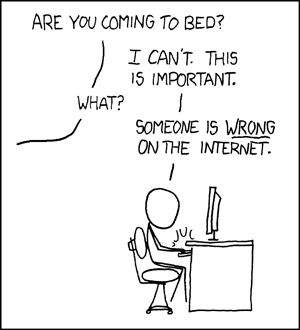
Don't think the IFT is a real problem? This week, Electronic Arts, the biggest game maker int he world, announced that they will be tying video game log ons to forum member profiles. Folks that are banned from the forums will also be blocked from logging into their games. That's right. Act like a jerk in the forum and you lose the right to play the game you purchased - and it is probably perfectly legal. Alexa reports that there are about 150 people are linked to the above comic EVERY DAY, and searching for just that single comic page brings up 13,500 hits. (That's not counting reposts, copying the image to other sites, etc.) A similar XKCD comic on the same topic:
Title: Duty Calls Caption: "What do you want me to do? LEAVE? Then they'll keep being wrong!" I had internet access when I was in high school - one of about a dozen people in a large suburban school. Needless to say, the whole idea of the IFT is somehow ingrained in my psyche, as if I can't imagine the world without nutjobs causing havoc only because they can and no one knows who they are. It isn't a new concept, but it is so frequently and strongly reinforced with the advent of the web that comparing it to throwing caution to the wind on vacation because no one knows who you are in Slovenia, just isn't the same.
So, again, how does this lead to the collapse of the publication industry? It's almost a V for Vendetta scenario - an establishment continues on the usual course where one side is suppressed, the other running wild, and eventually this exact problem comes to light. Maybe it is a cancer treatment or some other research paper that leads to significant outcomes that affect a large number of people, but the word gets out that the journal 'suppressed' the finding because an IFT compliant reviewer used the journal as a proxy. I think the average non-scientist thinks that we all constantly collaborate and get along peachy, and once that facade crumbles they'll wonder what other amazing unpublished findings their tax dollars paid for.
Well, that's the grandiose version. The more realistic version is that the amount and type of feedback available from internet based communication tools will become recognized as better than any of these old timey techniques. Seriously, the current model is one step up from sending typewritten transcripts via post. Of course the journals know this, so they'll probably be the ones to spearhead new models of research review.
And the point of all this appears to be that I'm just disappointed and annoyed that the world doesn't work at my speed. :P
Enough rambling. Time to work on the SfN itinerary.
I know we usually cover lighter topics and that the presentation at DNI is often on the more flippant side, but I think it is important to occasionally reassess the real, serious implications that come with any medical research. So, in the spirit of reminding everyone of one of the many reasons we do this work, I thought I would point out a couple video clips on CNN regarding a 23 year old man who, after becoming paralyzed during rugby practice, opted for suicide.
There are a number of topics to think about when considering stories like this one. While working for Phil Kennedy, the producers of Chicago Hope consulted him on BCI technology for locked-in patients. In the episode, after successfully restoring communication, the patient just said that they wanted to die.
To some extent, I like to think that just having the prospect of technologies like neural interfaces gives some hope to those that could benefit from the them. In fact, part of the reason that DNI is so light hearted is that I know prospective users will stumble on this site, and rather than ramble on about technical minutia and incremental developments, a little silliness and discussion of broader topics should (hopefully) break up the monotony of wading through numbers, error bars, and scientifically inept mass media reports.
If you keep up with the neuro shared items feed, I think one message regarding the field should be clear: Hang in there. We're on it!
What a sweet looking little interface on the upcoming BenQ MID.
No, I am not a Linux user, and especially not a fanboy/fanboi, but from an interface design perspective, Linux is poised to become the clear winner of the alternative interface wars. The reasons are simple.
A) No corporate identity. If a Linus distro wants a certain branding-type identity, someone just branches the distribution and codes away. The roots of this 'feature' are in the design of X Windows and the various window managers, like KDE and Gnome, and the philosophy that the interface is an extension of the underlying commands in the system. Don't like that Apple menu bar at the top? Sick of a certain Start button? Too bad. Millions have been spent on figuring out how big to make the menu fonts, the order of each item, etc., and with widespread adoption of Windows and MacOS in their iconic interface form, probably 100x's as much money is spent on making sure version X.5 looks and operates similar enough to version X that people won't be calling tech support and businesses don't need to retrain employees - a huge time/money sink, and one that is almost never budgeted.
B) The unstoppable march of the digital device swarm. While the popular WMs are still 'meh' in many respects, they have also been competing with highly organized, profit driven companies with millions of dollars spent on consumer research. People generally don't go to Linux because it is particularly easy to use of good looking, but now that companies are starting to put dollars behind Linux interface design (due to it widely being recognized as the Achilles' heel of Linux) the money factor is about to change. Netbook, MID, smartphone, and specialty computer makers are realizing that they don't need all the library overhead and background processes used in a modern desktop OS on devices meant for stereotyped tasks. The result? Better battery life (fewer computations, simpler computations incorporated into low level, modern instruction sets, less disk access), faster performance, and fewer errors/crashes/conflicts.
C) Multimedia barrage. I remember downloading MP3s back in 1997, while at college. You better believe that once I found a patch cable long enough to reach my stereo, my room was THE party room in the dorm. Pissed off that smug bastard with the 100-disc CD changer, too! But, seriously, if there is one positive outcome from the RIAA and MPAA* suing instead of innovating, it is that media formats have remained mostly the same. Good thing they spent years and tens to hundreds of millions of dollars to find out people want to play the music they buy on any device they choose (give Apple time - they'll pack it up soon enough), because the encoding and decoding to the few popular codecs used now can now be done in hardware. Before this stagnation, it made less sense for, say, NVidia to put mpeg decoding in hardware, or at least to repeatedly refine the ability in order to consume less power and operate with better stability. Same goes for software. Coders have been given the time to optimize, understand, and tweak media decoding. Sure there are a couple dozen different codecs floating around, but that could have been much worse**. Let's not forget that the whole open source software movement was also figuring out how to work out collaborations among many programmers in sparse locations at the same time. The result is that we now have cell phones running full motion video, etc. On the Linux side, this has translated into valuable time to support modern media formats (attract media type programmers to a decidedly computer-y OS, work out revisioning logistics, create a legal base/consciousness within the community). Without the benefit of corporate talks/alliances/contracts, OSS needed to implement media-centric features in a stable and reliable fashion. That has been largely accomplished.
* - To their credit, the MPAA has been MUCH more reasonable on this front, which is why I still go to movies and pay for rentals, but have not purchased a new CD or a paid music download in at least the last 6 years. I've contributed to artists through secondary means, like concerts, buying games they have tracks on, and snatching up any DVD-Audio they might possibly release. ** - Innovation on the media front has been largely squashed by acceptance from IP holders, once they figured out people were copying content for free. Any new attempt to make a better codec would run the risk of be legally hammered into oblivion if it gained a sizable user base, mired by copy protection at the insistence of IP holders, or developed far enough for the owners to sell it off, get their money, and run. The legacy codecs we use are there only because corporations acted so remarkably slowly and then started a legal shit-storm for anyone associated. When was the last time you saw someone distributing a product for free to millions of people, customized to their exact tastes and with immediate access, and it took the IP holders years to even recognize its existence?
D) Dr. Halo or How I stopped worrying about my child's social life and learned to love the video game. And, thank video games for unstoppable march of realism and complexity in 3D environments. Unlike video, which has several targets (movie, transmission, streaming, local playback, etc.), video games have had relatively few, making hardware the limiting factor. We can argue about changing 3D standards helping this, but the mantra of "if you're not maxing out the hardware, you're not taking full advantage of it" has egged developers on. Video games also pioneered the HUD, menu system, navigation nuances, and many foggy cognitive features of human-computer interaction that we probably won't even scratch the surface of over the next 50 years. While 3D support for Linux is still largely dependant on how nice the hardware folks was to be about releasing source code (which varies greatly), basic 3D operations have been removed from proprietary APIs and placed in lower level, quasi-auto-detected interactions of hardware and software (instruction sets), optimized at the library level, and generally more 'universalized'. So, while specular mapping from 8x anisotropic filtered internal reflections on bump mapped surface of a volumetricly rendered light source might not be in the cards right now, fade rectangle and rotate isn't a big deal, and that's all you need to a neat-o menu effect.
E) A new breed of 'digital ready' people. 97% of school children play video games. 1% of incoming freshmen at colleges have land lines, while 99% have cell phones. 17% of US homes overall (including mine) have only a cell phone. How many high school students do you think have ever seen a hand-cranked window in a car? And for the parents, remember when YOU discovered Playboy/Playgirl? Yeah, imagine now. The biggest change in culture between the PC of 1995 and today is the user, and this is arguably true for any type of significant tool at the timescale of generations. We evolve with the tools we produce because of the tools we produce. This rule applies to culture as much as it applies to the mess of neural networks in our heads.
Younger folks, and I like to include myself as one, just 'get' electronics. We can fuck with a car stereo for 30 seconds and, through some ingrained, trial and error process, figure out how to set the clock, add favorite radio stations, and contact the International Space Station. Whether it is Windows, Mac OS, Linux, BeOS, AmigaOS, or whatever, as long as some thought was put into the interface, we're (mostly) fearless. Yes, grandpa, we know all about how efficient the command line was for punch card computing. Unless you are actually interested in computing, no one cares. This is where the Mac has generally shined, but mostly because it was only compared to Windows, and generally from the perspective of someone with enough familiarity with both to know that both tools would accomplish the tasks they needed a computer for.
Once this seemingly innate understanding of computing interfaces is understood, it will be implemented in niche devices. Right now it is mostly trial, focus group testing, and error, which has taken us far enough that device makers for low adoption devices to get some pretty slick interfaces. Once we have better rules and theories about the Generation X (or Y or whatever this generation is called) specific differences in HCI, it will be easier for those closest to the goal and with smaller user bases to adapt. Those devices are largely Linux based.
Anyhow, don't wipe your PC yet. I'm not talking about desktop computers, and those are likely to run a completely different course. But, don't shy away from other devices because they happen to have an unfamiliar interface. You might just find it more usable than your *ack!* iMac!
I know posts have been sparse here (the Digital Trends people haven't heard from me in months, really) but like usual, I am being overly ambitious on large projects and having to justify it while secretly plotting even larger ones.
Really, it comes down to having left the research world for 4 years, I expected some basic experiments to be completed. They're obvious, elemental, and simple, but act as cornerstones to further development. They weren't. Honestly, when I returned to academia, I didn't know what kind of project to work on and after a few talks with my advisers, it became clear that next to nothing I perceived as the logical next steps was accomplished. I actually remember the exact moment when it hit me - during a meeting when I was asking for thesis project suggestions. I recall literally stopping, staring off across the room, and thinking that either a) it was really a verify this in greater depth type of idea or b) Wow.
It isn't 'bad' - the push has been towards taking state of the art techniques and philosophies built from monkey work and applying it to the human side. Makes perfect sense. The problem is that there should always be a parallel thread building on the basic/elemental side of the equation. Working in people is different from monkeys (obviously), but the two biggest differences, and it takes some serious hammering to get them into your skull, are that you have the ability to convey concepts (not just processes) through language and you have access to unobserved processes. That means:
a) No training is needed for task familiarization (not talking procedural memory or 'mastery') a1) Replication of monkey experiments should be performed at breakneck speed. (Erm, unfortunate pun, but I leave it in because it correctly conveys the idea. Just noting that I did catch that.) a2) Papers based on replicating monkey experiments require less effort (tasks already coded, expected results and caveats already mapped) and report less significant findings (i.e. - they become "Worked in monkeys. Yup, works in people." comparative studies). a3) Should require either a novel functional outcome ("We can therefore do X with a BCI.") or provide insight on a monkey-impossible phenomenon ("Think about grandma's apple pie while you do X.").
b) Almost any experience once relegated to the world of 'cognitive neuroscience' becomes admissible. I know what it means to "recall the scent of a new car", so do you. Most of us do. There might be significant variance in what that scent actually is, but in understanding 'the brain's response to imagined new car smell', we all know the subject/object of reference. Take out these accepted experiential elements because of the artificial distinction in neuroscience sub-fields, and I would argue that ascribing any neural activity to any unobserved process (preparation, reward, saliency, etc.) must be eliminated, too. Sorry, no ascribing unobserved forces to activity, since you have no ability to say with complete certainty that monkeys operate in a conceptual/cognitive manner similar to humans. You're just anthropomorphizing mental or neural processes based on statistically significant relationships in a constrained environment, and you're dissociatingenvironmental cues, not internal representations. Does that colony of monkeys happen to be full of synaesthetes? How many times do you hear, "Yeah, the monkey just didn't want to work today"? Or, "Yeah, the monkey got bored."? So, the data is collected only when the monkey "wants" to work?
So, in short, human BCI experiments should incorporate 'cognitive neuroscience' techniques in order to enrich the functional/translatable significance of the outcomes. I love to use the example of crossing the street. A BCI user should be able to recall crossing streets, imagine crossing the street in front of them, tell a joke about a particular chicken crossing a street, point across the street, and want to get to the other side of the street without stepping into traffic. Otherwise, we're doomed to becoming glorious reflex arcs.
(And for extra credit, imagine a world in which Sartrian angst is always acted on. Scary.)
Anyhow, I think that the state-of-the-art and elemental streams need to always be examined in parallel (even better in concert, but tougher to design and control). And, having already spent too much time typing this, I'll leave to you to consider why that is (hint: there are practical, moral, and theoretical reasons). Enjoy the brain twisting. :D
So, just a warning for those of you coming in for SfN. It appears, oh man, I mean really, I... ugh it appears the Department of Homeland Lunacy now has the power to confiscate anything that can hold data - digital or analog - indefinitely. That means iPods, PCs, pads of paper, napkins, and you're really fucked if you jotted down a quick note on your hand. Seriously, folks, we have no idea what's going on at this point. We're trying to fix it. Apparently this the 4th Amendment was just kind of a recommendation.
I'm wondering how this will play out in the BCI field, since many researchers have confidential information, either patient, company NDA related, or time sensitive data. So, backup everything to a drive that you plan to leave behind. It might be a good idea to leave it with someone you trust, too, cuz we detail Icelandic girls here. Yeah. We're threatened by Iceland. I mean, sure if we were all Polar Bears, or trees, but ah forget it.
Next, grab a copy of TrueCryptand if you're adventurous enough, try the new features, that include completely masking the entire boot drive with a fake OS partition. For those more conservative, just lock it down with the strongest encryption you can select and hide the files in an unassuming directory. Not Music or Movies, since our government is also the RIAA/MPAA's lapdog and will be checking those. Throw it in a place that it would be reasonable to find large files of odd types, like a Program Files/Adobe/AdobeBackupRepair. Split them into different sizes, name them things like ClientPermissionsRepair.dll, FlashPluginUpdater.bho, etc. I haven't checked, but I assume the actual encrypted files have no header info to identify them as encrypted. Clear out your Windows logs (Google it if yo don't know how), and of course run TrueCrypt from a flash or external drive. Wipe the unused space with something like Eraser, delete Eraser or other secure file deletion programs. Generally speaking, modern hard drive platters are mostly unreadable after a 7-pass algorithm, but the more paranoid may want to spend the time with a 35-pass Guttman.
After all, our laws are more to make the morons in our country feel like they are being listened to. They are totally ineffective in combating their primary objective and just serve to make those of us with any gray matter scared to challenge the gov. Pathetic.
Ah, Microsoft. You seem to do nothing as people rip on your pretty new OS, and then you give us this gem. What did they do? Asked critics of Vista to try their "new" OS, called Mojave. They brought a camera and let the poor dolts fondle this highly classified project. Opinions were very favorable, and the critics were satisfied that this upcoming OS was going to correct the flaws in Vista. Oh, and Mojave? Yeah, doesn't exist. They were using Vista.
Overall, I'm pretty happy with Vista. It isn't great, it isn't horrible, it's just the 'next thing'. My advice is as follows: If you are using XP and happy, stick with it until you are convinced that you need the added security or Vista-only features (most of which can be performed in XP with available 3rd party programs). If you are someone that likes to upgrade to the latest, but have been put off by the talk, just install it already. Hell, dual boot your system until you are convinced it will work. You can purchase the retail DVD containing all versions (check what you order to see if it the version that also includes the 64-bit disk) of the OS, but without a license, for $20 online. Install it, mess with it for a couple weeks, and if you like it, go grab a copy of the upgrade version (use this to "install" over the version of Vista you already have installed, thus allowing you to use the "upgrade" license number). You can grab a copy with SP1 integrated, and the license number will work for 32 and 64-bit versions. But doesn't it cost a billion billion dollars? Close. On the high end, Ultimate upgrade can be found for $180 online, and $70 for Home at the low end.
This, what I guess passes for an article at Fox News, mentions 'The Lab' along with my old 'The Lab'. The quotes, images and, well, all the content regarding the current 'The Lab' is straight out of video clips or other publicly available material. I think they were just going to write an update on Phil Kennedy's work and the reporter needed to add some fluff. So, go ahead and take a peak if you want. You might want your 5 minutes of life back, though.
In REAL news, can't say anything more, but you might see me in the background on a upcoming major news show airing in the Fall. not saying anything more until everything is public, but that's part of the reason for the slowed updates lately.
And just a quickie on the first topic. I find it odd that every 6 months or so, there is an update on the project here. I mean, yes, we make progress, but the updates seem to come randomly. Sometimes they're started by a rogue Reddit or Digg post, sometimes there's a big media blitz. I know that there are times when the company is looking for investors and when we get publications, where I expect media coverage, but at least half the stories I've come across have been completely out of the blue. The only possible conclusion I can come to is that people are weird. That is all. If you read the Fox article and read this, I bet you want your 10 minutes of life back. Too bad, they're mine now.
I am still amazed by how few people in academia use RSS. Seriously, people, get with the program. The other day I was sitting in a meeting and the PI asks, "Hey, what's (one of those labs we always watch for new papers) latest paper?" I pop up Google Reader, hit my PubMed feed for that search and start rambling off the last 5 papers. So, though I mentioned it before, here is an updated primer on RSS use in research.
First, though, why use RSS? - You never have to navigate confusing journal sites, deal with their crappy search engines. - You are instantly updated on all info in the field without having to do anything beyond the initial quick setup. - All data is portable. Don't like Google Reader? Switch to another RSS reader and bring your feeds with you. - You can build in your own way of prioritizing topics. Feeds take up no room, they don't care if you look at them every day, or once per year. - Sharing info is remarkably easy. Sharing queries allows you to keep the whole lab on the same page. Feeds can be shared, posted on web pages, given to new lab members, created on the fly, and many other aspects that make collaborating easier. - Archiving easily. You can mark the stories you like, and then create a feed out of those. You want the lab to read a specific paper for lab meeting or journal club each week? Just mark it. For example, I don't have everything set up perfect right now, but if you want a sneak peek at the stories I will discuss on the next Digital Trends Podcast, here's the feed.
PubMed PubMed has the option to create custom feeds for any query. Here is how I have it set up, and highly recommend it. There are 3 phases to PubMed RSS optimization:
1) General Topic Tracking PubMed's sloppy search engine can annoying. Say you want to keep up with motor cortex papers. Searching "motor cortex" returns anything with "motor" and "cortex", which includes molecular papers about protein expression, etc. That's okay. You could always learn a thing or two from an off-topic paper. AND remember that you are not obligated to read ANYTHING in the feed. You can tap the "Mark all as read" button and poof, they're gone. I use several general searches that I go through last when checking my feeds. I think they're still valuable to have, since every once in a while they catch a gem and might stimulate the creatively looking at questions from multiple angles.
2) Specific Topic Tracking Alright, the nitty gritty of PubMed. No, don't bother to learn all the syntax. Just hit the "Limits" tab, which lets you set up filters. Here is where you will spend most of your time. If you have played around with the general search, and have around 5-10 important, recent papers that you know were essential, start tweaking your search so that all of those papers show up in the results. Don't confine yourself to one search, either. You might have papers on, say, motor cortex and movement trajectory decoding, and you might have another set on LFP activity in any cortical area. Fine. You have two feeds you want to create. One "Motor Cortex Decoding" and one "Cortical LFP". Don't be afraid to make too many feeds, since you are looking to make this section as specific as possible, but also as accurate. Yes, PubMed can suck if you don't know the details of how it searches, but you can take the time to do a very specific search with the correct wording because it will be the last time you ever use that search again.
3) Important Author/Lab Tracking Of all the searches I do, this has been the most useful. You know the labs you want to watch. Note the most important folks (PIs, and any collaborators). Search for each set of specific authors (1 per lab), so something like "Donoghue JP[Auth] OR Hochberg LR[Auth]" (no quotes). Create a feed for each.
Individual journals Almost all journals have the option to subscribe via RSS. You can keep up with the articles if you want, or just have the feed handy rather than having to navigate through the journal's site. "Hey, did you see that paper by Monosov in Neuron last month?" I just went from this browser window for this post to the answer in two clicks. THAT is powerful.
Individual sites Like DNI, Digital Trends, TechRIVET, Ben's Bargains, CNet News, BoingBoing, and MetaFilter? Check them every day? Wouldn't it be easier if they all appeared in one place and you never had to hit up the site if there wasn't anything new? RSS readers will tell you what's new, let you categorize your feeds, flag stories with keywords, and make every aspect of your browsing easier.
Coordinating with others In Google Reader at least, there is the option to share stories and attach notes about them. "Hey, check out the methods section. I think we could use that for our blahblah work." No coding up html, copying and pasting, emailing, etc.
Offline and online and via email There are many RSS readers, both in standalone and online format. I'm not going to review them here, but I like Google Reader, since the Google Gears component allows you to take it offline as well. You can also have your feeds sent to your inbox using Feedburner or RSSFWD. Outlook 2007 has built in RSS support as well.
I went from 2-3 hours of active browsing per day for tech and research to around 10 minutes. I have returned to around 2 hours of browsing per day, but now I read around 1300 stories/day (by "read" I mean read the title, decide if I want to read the story, etc. I actually read about 20-25 full actual stories per day.) For example, I haven't hit my "General" folder yet today... Anyhow, back to work...
I know, no posts and then I post something utterly unrelated.
But, if you are a part of net culture, you owe it to yourself to download the new Nine Inch Nails album, which is free. No, not as in "find it on bit torrent" free, but as in on Trent's site, with a the note: "as a thank you to our fans for your continued support, we are giving away the new nine inch nails album one hundred percent free, exclusively via nin.com."
So, yes, go get it in any of several formats, including better than CD quality WAV, MP3, lossless, etc. Even if you download it and delete it, show your support for changing the music industry through REAL dedication to the art, not that namby pamby marketing stunt crap that Radiohead pulled. Reznor has been single-handedly turning the industry on its head, and this is just the latest. And yes, he is still making money doing it.
One of my friends here, a certain Icelandic diva, likes to joke about how I am an information hoarder. I have way more tech stuff than I actually need/can use, and that goes especially for media. Books, music, bookmarks, podcasts, movies, etc - there is no way that I could finish it all. I could sit at my desk without sleeping for the rest of my life and never finish the contents of a single "hoarding" collection on one hard drive. I love the crazy as batshit stuff, too, probably because it is harder to find.
Every once in a blue moon I go through and try to eliminate total junk, which usually consists of asking myself, "If someone saw that I had that, would I be extremely embarrassed and completely lack any explanation?" Nothing nasty, but certainly socially unacceptable stuff occasionally finds its way to me. (For example, I love conspiracy theories for the sheer lunacy and fun of it, and the whole act of suspending disbelief stimulates me to look at things differently from even the most basic levels. But, growing up in a Jewish family (I'm 'socially/by blood Jewish, religiously atheistic') I don't feel comfortable with Nazi or controlling-the-banks-and-Hollywood type items. Not that I wouldn't get something out of reading them, but I feel like I shouldn't support it since the 'real believers' are a special kind of scary.)
I think part of it is that having all that information locally increases my sense of comfort, since any bit of information is sitting right in that little box two feet from my left hand. Give me a sec here, and let me tally up how much storage I have... ~7TB of harddrive space and ~50GB of flash drive space. No, it's not all filled, but that's only because I have a certain level of standards and haven't downloaded a movie in ages (stopped that around 2004 - with the exception of documentaries/learning-related/can't be found on Netflix stuff).
I think my mentality on the subject started when I was in high school and got introduced to the Hacker Manifesto during my early AOL haXoring days. It isn't a malicious thing, but more a curiosity. I prefer to think of myself an an information merchant.
Oh, sweet, sweet procrastination. I have defragged my hard drive, run a virus scan, reindexed all my files, but there is always you, Internet. You are my favorite source of procrastination. Uh, (cough) sorry.
(Edit: While typing this, you might think I just had an idea shot down or a frustrating meeting. that's not the case. The articles linked toward the end were the thing that inspired me to write this.)
When designing tasks, especially for human types, it makes sense to take a step back and make sure you covered the basics. Too many times I see task design go to committee when all that does is soak up time and energy. There are two parts to any interface design: Style and Technical. Style is that inexplicable, non-critical bias we all have. Technical ensures that the task answers the intended question. This all goes awry when we start nitpicking. By nitpicking, I mean minor changes based on loose evidence that happens to be significant in some cases, but not in the one in question. I strongly, strongly, strongly urge all labs involved in interface design for behavioral tasks to do two very simple things: 1) Limited the number of people designing the task to 3 at the maximum. 2) Make a checklist that every task must pass.
Three people? Yes, well no. Two people! The process goes like this: START with style. The 'creative' person (who also implements the task) should design the interface. The 'technical' person should ensure that it answers the question. I'm assuming a lab situation where no one is an idiot, so the technical person is really scrutinizing the actual science and comparing it to other similar tasks with a more critical eye wile the creative person is more concerned with fitting it into their overall scheme/study. The creative person should be the less experienced, the technical a post-doc or PI. Any concerns pointed out by the technical should be handled by the creative in whatever way they see fit. The result should be discussed between the two and then presented to the third, who has had no influence on the design. This meeting should be no longer than 30 minutes.
So, it goes: Creative -> Technical -> Creative -> Technical/Creative -> Outside Confirmation (-> back to Creative/Technical if significant issues identified)
You may say, "That's what we do!" I doubt it. Having worked in five labs and three companies, no one has an actual process. It generally begins with a discussion in a group where personal bias is introduced and emphasized before the actual task or interface creation. Advice is sought by multiple people, sometimes because of expert opinions or a wish to collaborate with a specific person, which means the nice linear design above branches by N! times as each change and objection is propagated throughout all involved members.
It is still important to get everyone's feedback and make sure other lab mates know about the tasks, so presenting it to others is still a good idea (isn't that partially what lab meetings are for?), but when presenting, do the following: - Any idea that doesn't relate or has previously been discussed between the group of three should receive a, "that's a good idea, I'll look into it" response. Do not explain, do not argue, and at most ask why that's significant. You do not need to rehash the last 4 months of interface design to someone that wasn't involved. They were interested, they had a good point, thank them, maybe rehash in your head what your previous conversations were about concerning it, and move on. - Any undiscussed ideas or unknown sources ("The X lab did something like that, but did X(i)") should be written down and assigned a value 1 to 3. 1-not important, 2-medium or UNKNOWN importance, and 3-Crap, should have thought of that. Address those issues in that order. Address the #3 issues immediately after the meeting and look up the info for unknown sources. make sure all three people have assigned the same values to the identified issues and leave the creative/subordinate to iron them out. Repeat the linear approval process above once these new issues have been resolved.
You are now done. Sounds long, but it really is about 1 week. Each step should take around half a day so you have time to mull over the info. Don't throw things up the line that aren't done, don't meet in between to discuss anything other than the vital issues and any possible implementation problems. The creative person is the one most vested in seeing the task done right, and will make sure the design goes through.
This is how businesses work when they hire designers. The designer(s) (usually 1-3 people), meet with the client, find out who they are trying to attract, get enough technical details to know what the business is and is not, leave and take time without any company involvement until the next formal meeting, meet to present several sketch ups of the final product, return to the studio to alter the chosen mock up to the specifications, call/email/fax the final design, get the approval, and make the widget. For bigger things, like whole websites with many categories, each meeting will discuss a specific subcategory after an initial unifying design meeting (similar to a student meeting with the PI to discuss his/her thesis work).
In order for this linear design to work, each hand off of the task should be preceded by a checklist. A) Who else has done this task? What were the major problems and are they more or less a concern for you? B) It is technically and financially feasible? C) What about the currently available setup needs to be changed? D) Does it conform to the following (what inspired me to write this whole babbling article): http://www.componenthouse.com/article-21 http://www.componenthouse.com/article-22
LAST) Does it still answer the questions you are looking to ask?
If you were waiting on buying a high def player, wait no more. HD-DVD is all but dead. Go ahead and get a Blu-Ray player. If HD-DVD wins at this point, I will buy every reader a flagship HD-DVD player. (Lost several major studios last month, recommended by Best Buy last month (read: uneducated masses will have to hunt for the HD-DVDs in the store while Blu-Ray on end caps and with demo stations), now no longer carried by Walmart, no longer carried by Netflix, and Toshiba now suspending the actual manufacturing of the discs.) BUT...
There are several Blu-Ray 'profiles' - 1.0, 1.1, and 2.0. Current players are only in the v1 realm, and the only firmware upgradeable player is the Playstation 3. What does this mean? Profile 2 basically just adds the ability to access online content. If you can do without that, you can get another player. The profiles refer to added features, and if you get a "profile 2.0" disc, but only have a profile 1.1 player, you can still play the disc, just not access the 2.0 specific content.
That being said, the PS3 is not an ideal Blu-Ray player for two main reasons.
1) The remote is RF only (actually Bluetooth), which means that if you have an all-in-one remote, like the Logitech Harmony line that I LOVE, it is useless for controlling the PS3. There is a 'work around' to get IR support that involves getting an old PS2 IR remote and a USB to PS2 controller adapter, which might be worth looking into if you plan on making the jump.
2) It is loud. Not jet engine in the living room or XBox 360 loud, but more noticeable than a standard player (it starts off near silent, but around mid-way through the movie the fans kick in). Nice comparison (don't trust the YouTube videos).
Turns out that the artsy little Cable Car Cafe was showing The Diving Bell and the Butterfly all this time (they don't show up on the major movie theater sites). Saw it last night, and here are some general thoughts.
First of all, everyone in this field should both read the book and see this movie. The book is a more somber, introspective experience, forcing you to take some real time to consider the situation of the author (locked-in due to brainstem stroke, communicating with a single eye blink). The movie makes a bigger deal of the author's relationships with women (his children's mother, his lover, the speech therapist, anything with mammary glands), but it somehow brought it all together. I guess watching two hours of deadpan, introspective dialog just doesn't make for enjoyable viewing.
The majority of the movie is shown from the perspective of the patient (Jean-Dominique Bauby, former editor of Elle Magazine), and was truly a remarkable experience. Later, the camera does leave his body to focus on him, but the way the director goes about it is extremely artistic and at the same time respectful. Rather than hit you with the image of Mr. Bauby in his immobilized and distorted state, he makes you relate to his condition without considering the visible impact - the distorted lips, the bloodshot eye, the trach tube, etc.
I don't want to give away too much, or describe it in too much detail because some of the stark transitions and imagery is meant to be experienced as part of the progression of the film, but it was remarkable on every level. Artistically, it felt like every shot was intentional, telling its own story. The actors and actresses were just amazing. The pace was good, and the organization well thought out. I simply could not have been happier.
On the 'mechanical' side, it looked to me like everything was well represented as far as the medical issues (though I assume they removed much of the lung suctioning because it can be a little disconcerting to people not used to it).
Mathieu Amalric does an incredible job of depicting a locked-in patient. There is one emotional scene that really hit me hard. If you saw it you probably know which one it was, but Bauby's emotional response to a situation, only being able to move that one eye, was downright haunting. I've seen that look of helplessness and panic, and it brought up memories I try not to think about. Amalric's portrayal is spot-on exactly accurate, perfect, wow, can't even say how surprised I was.
Thankfully, the movie is not all about helplessness. It is in some ways uplifting, with some great scenes to match, and part documentary. You'll leave the theater quietly thinking about the whole experience, but not in the "that was so sad, I don't want to speak" sort of way. You can't help but reflect on each scene and each transition. Each moment is its own story or point to meditate on. While I wouldn't say the movie is uplifting, it wasn't depressing either, which I think was the director's attempt to catch the spirit of the book. It has been almost 10 years since I read it (now I plan on rereading it), but I remember a similar feeling. It's the Existential feeling of - this is what it is to be human, the good and the bad. One doesn't exist without the other, and you can't choose to ignore or dwell on just one aspect of your humanity forever.
People say that it isn't what you say that makes a person, it's what you do. But, then what if you can say or do nothing? That is what this movie is about.
IMdB link Official Site Amazon book link Netflix queue link Fandango theater search (be sure to check your local artsy locations, too. This is a 'foreign flick', so expect it in smaller venues.)
So, quick post on my TabletPC enthusiasm/addiction.
My Gateway CX210 tablet, which I have a love-hate relationship with had some issues. Nothing major, but enough that I wanted to send it in before the warranty expired. A motherboard swap was in order, but the piece wasn't in stock. SO they kept my baby for 2 weeks and when it still wasn't in stock, they sent the system back to me unrepaired. Two weeks later they got it in stock and after all the fuss, the swap didn't solve the problem. Annoyed? Slightly. So, they were going to swap out the system for an entirely new unit. Being the sly guy I am, I asked if I could pay some sort of upgrade fee for the latest model. I get a call a few hours later letting me know that I will be a brand new, just released, maxed out system. It's nice to see some companies still valuing their customers like that. While it was annoying to lose my system for that long, replacing a 1.5 year old system with a brand new one shows alot of class.
So, I bring this up because the time to get a new PC is just about here. The Penryn chips and latest motherboards are starting to trickle out. The next iteration of systems, as in the ones you'll see in ~8-10 months, won't be adding too much that the average user will notice (anyone care if they have an on-chip memory controller? Thought so.) Penryn systems with their 45nm goodness are starting to hit the streets as we speak. Gateway just upgraded their desktop replacement tablet system with the C-141X and XL. When checking, look for these processor numbers: T8100, T8300, T9300, T9500, X9000 (those would be 2.1, 2.4, 2.5, 2.6, 2.8GHz (quad) respectively).
For you Mac peeps, by the end of the month there should be refreshes of the MacBook or MacBook Pro or Both. Why? Penryn shipping in volume for one. Multitouch for two. Apple has learned long ago that adding funky new Mac-only tech one one item can steal sales from other lines, as people wait for the feature to appear in related products.
So, for Tablet PCs, there are: Gateway C-141X and XL (14" screen means a full page of text.) Toshiba M700 (Tied for my first place choice. Smaller screen. Lighter.) Fujitsu T4220 (not upgraded to Penryn yet) Dell Latitude XT (way underpowered CPU, but much-hyped screen and digitizer) HP tx2000 (AMD CPU = yuck) Lenovo ThinkPad X61 (considered one of the best universally, but lacks widescreen, and a has a slower CPU)
From the point of view of someone that needs some decent number crunching power, the Gateway and Toshiba really stick out. It's not the most portable, weighing in at the same weight as a 15.4" system, but it gets the job done. Note that Gateway got it right on the RAM. Don't bother with 4GB of RAM - Windows will only see 3GB. If all you want is a ssytem for reading/annotating papers, note taking, and surfing, any will do, though the Dell will feel a bit balky. I would probably go with a 12.1" version, like the M700. to keep the weight down. Just make sure the battery lasts a while, or that you can add a modular bay battery.
Another option is to use a regular laptop and get a Wacom Bamboo or Bamboo Fun pad. They're essentially USB digitizers (work on Mac and PC), that just lack the nitty gritty of the more popular, artist-intended Graphire and Intuos lines (no tilt detection, and a 'measly' 512 levels of pressure). I was seriously considering this route, until my whole system was replaced. I might still pick one up for my home PC. I'll post a link to the Digital Trends review when I do. Got my eye on the medium sized silver Fun edition. Not sure if you want a full time tablet PC? Grab one of these for $70 and mess around with it! (The Bamboo is around $70 online and the medium Fun version is around $170 (at Costco).)
As for a Mac tablet, don't hold your breath. There's the ModBook, which is shipping so slowly that I still can't get a review unit. Then there's the rumored Apple official version. Expect it to drop mid next year at the earliest. There are a number of reasons, but just from someone that has watched the Apple product cycle for years and knows the tech business pretty well, there is no way we will see it this year, and it would be questionable to see it next year.
Happy scribbling!
(Update: Engadget has a nice breakdown of the next iteration of laptop chipsets, dubbed Centrino 2. Right now is the best time to get a system if you plan to keep it for under 2.5 years. The only major upgrades on the horizon are 1) faster bus (rarely the major bottleneck in laptops) and 2) DDR3 support (ridiculous prices now, and expected to drop around mid next year). The only other thing I forgot to mention is that 500GB laptop drives should hit the shelves by next month, so if you store massive amount of data, maybe a one month wait is in order.)
The Free Geek sent me a heads up an article on his site titled "The DIY Guide to Becoming a (Real) Cyborg". It's a nice mix of real/existent technology, things on the horizon, and the first steps in other directions. I love these types of articles, and had a [warning: confession ahead!] Extropianism obsession when I was in High School. Now I'm more cynical, but I like to support that sort of unrelenting optimism. I'm what Robert Anton Wilson called an 'angry optimist'.
I thought I'd pose a quick question. Besides my glorious Super Paper Fridays, how do YOU keep up on the literature?
I use Google Reader and subscribe to journal RSS feed, along with feeds created on PubMed for common searches (same with Science Direct). I've been thinking about trying out Yahoo! Pipes to filter staff better as well. Any thoughts?
Michael Moore's new movie Sicko is on Google Video. The whole thing. Moore has been public about his wanting people to see it whether they "pirate" it or not (his word), so I don't feel bad passing it along. Having worked in "Big Pharma" for 3 years, I was surprised how little flack the pharma companies got. They deserve much more, but I guess the point of the film is much bigger than your usual "greedy business tries to dupe customers" line.
While it doesn't relate exactly to BCI, I have to wonder how things at small research based medical device companies would be under socialized healthcare, and how that would impact research money (in the US, if you tell someone you do research, they immediately ask about what kinds of medical conditions, not what subject
On a related note... after watching that, can someone explain why I still live in the US? Any of you Euro spending types wanna chime in on what was skewed?
[Update: Looks like Google removed it. Poo on them. The torrent will be up until the end of the Earth, though.]
I cannot imagine how it feels to deal with the loss of an appendage, and how that alters the image a person might have of their own body. It must be one of the most difficult challenges a person can face in the way it impacts them in day-to-day life. But, there are those that have taken this taboo topic and really shown beauty is more than just skin and bones. It gets me thinking. Is trying to hide the issue actually causing the insecurity? Does amputation amplify preexisting insecurities and provide something to blame for one's poor self-image? We've become so used to trying to cover up our blemishes with a never-ending contortionist's game of makeup, surgery, and fads that maybe just being 'real' is refreshing.
Gizmodo and MedGadget have featured Lisa Bufano's dance stylings this past week (pictured above, video at Gizmodo), but I thought I would also point to some photos of the beautiful Aimee Mullins (pictured below). Do a quick Google image search for some of her racing and fashion pictures, and prepare to be awestruck!





 I cannot imagine how it feels to deal with the loss of an appendage, and how that alters the image a person might have of their own body. It must be one of the most difficult challenges a person can face in the way it impacts them in day-to-day life. But, there are those that have taken this taboo topic and really shown beauty is more than just skin and bones. It gets me thinking. Is trying to hide the issue actually causing the insecurity? Does amputation amplify preexisting insecurities and provide something to blame for one's poor self-image? We've become so used to trying to cover up our blemishes with a never-ending contortionist's game of makeup, surgery, and fads that maybe just being 'real' is refreshing.