Just awesome.
Oh, and SPF is still coming. I thought I would wait for Nature and Science to get out the door before compiling the last one of the year.
Showing posts with label science culture. Show all posts
Showing posts with label science culture. Show all posts
Sunday, December 21, 2008

Wednesday, November 5, 2008
What to expect
Now that the election has come and gone, where does that leave us? New Scientist has the scoop on the Obama planned science and technology policy (pdf here). They incorrectly state that 60 Nobel Laureates endorsed Obama. The correct number is 76 according to SEFORA.
Here's a rundown.
- Doubling the science funding over 10 years.
- Re-promotion of the Science and Technology Advisor to a cabinet level position. This will also be one of the first positions to be filled.
- Science and Tech committees will be chosen by their integrity, professional reputation, and ability to remain objective, unlike with Bush where you only needed to come from Texas and have a valid subscription to The National Review and Popular Science.
- "Grand Challenges" The first one mentioned is for alternative energy, but that is not the only one. This is the same idea as the X Prize that has been inspiring the private sector to literally reach for the stars. In other words: High risk will equal high reward. With the millions of dollars needed for realistically advanced BCI research, could the field be that far down on this list?
- Predictable, stable funding. Oh, sweet Lord, thank you.
- Multidisciplinary encouragement, probably similar to the NIH push for translational research. Of particular BCI interest, the example given is the convergence of nano, info-, and biotechnology.
- Tripling NSF grants. (Current chance of getting funding - ~19%)
- Treating broadband like a utility - everyone should have access.
- Emphasis on transitions from research to healthcare - listed the number one under health.
There has been no explicit mention of where the money is coming from. Chances are that the programs will be rolled out over a few years as troops are withdrawn from our various "Oops Wars" and taxes are ramped up for the wealthy. If we can find $700B to bail out Wall Street, we should be able to find a few billion to get the ball rolling. Besides, when The Economist and Warren Buffet approve of his economic policy, so before you rant about usual liberal spending or empty promises by politicians, there is some meat to back it up.
In general, the rock star technologies are stem cells, genetic engineering, and alternative energy, which are the big topics in the general media (and totally worthy of it - not trying to knock it by any means). BUT, the structure of the NIH and various funding agencies is such that the newly available money will be reaching other fields. For instance, NINDS (one of the institutes of the NIH, and a big, wonderful, amazing, omgomgomg can't say enough ;) ) will use the money to fund many projects on spinal cord repair, epilepsy research, and BCIs. It is in their best interest to diversify their investments, and the addition of the Grand Challenges makes to cover the rock star topics, more of those funds may end up in the BCI court. I hope. Another funding opportunity for BCIs is defense (DARPA, DoD, etc.), which is looking at getting a boost.
Other nice things to see:
- Return the emphasis on science, math and engineering for students and overall greater investment in education.
- More, better science teachers
- College tax credits
- Expansion of science education from K through community college
- Small business R&D tax credits.
- Fast Track visas for foreigners with technical expertise.
- Patent reform
There are also some giblets that seem to point toward better general infrastructure when it comes to tech - manufacturing, transportation, and IT research to name a few.
Overall, there is an emphasis on getting rid of this ridiculous, nauseating War Against Intelligence. The fact that ANYONE looked at Palin and said, "Yeah, I could see her as President!" is a testament to the jaw-dropping, knuckle-dragging stupidity that some in this country have embraced. Hopefully a few years of the Obama-rama will lessen that.

Here's a rundown.
- Doubling the science funding over 10 years.
- Re-promotion of the Science and Technology Advisor to a cabinet level position. This will also be one of the first positions to be filled.
- Science and Tech committees will be chosen by their integrity, professional reputation, and ability to remain objective, unlike with Bush where you only needed to come from Texas and have a valid subscription to The National Review and Popular Science.
- "Grand Challenges" The first one mentioned is for alternative energy, but that is not the only one. This is the same idea as the X Prize that has been inspiring the private sector to literally reach for the stars. In other words: High risk will equal high reward. With the millions of dollars needed for realistically advanced BCI research, could the field be that far down on this list?
- Predictable, stable funding. Oh, sweet Lord, thank you.
- Multidisciplinary encouragement, probably similar to the NIH push for translational research. Of particular BCI interest, the example given is the convergence of nano, info-, and biotechnology.
- Tripling NSF grants. (Current chance of getting funding - ~19%)
- Treating broadband like a utility - everyone should have access.
- Emphasis on transitions from research to healthcare - listed the number one under health.
There has been no explicit mention of where the money is coming from. Chances are that the programs will be rolled out over a few years as troops are withdrawn from our various "Oops Wars" and taxes are ramped up for the wealthy. If we can find $700B to bail out Wall Street, we should be able to find a few billion to get the ball rolling. Besides, when The Economist and Warren Buffet approve of his economic policy, so before you rant about usual liberal spending or empty promises by politicians, there is some meat to back it up.
In general, the rock star technologies are stem cells, genetic engineering, and alternative energy, which are the big topics in the general media (and totally worthy of it - not trying to knock it by any means). BUT, the structure of the NIH and various funding agencies is such that the newly available money will be reaching other fields. For instance, NINDS (one of the institutes of the NIH, and a big, wonderful, amazing, omgomgomg can't say enough ;) ) will use the money to fund many projects on spinal cord repair, epilepsy research, and BCIs. It is in their best interest to diversify their investments, and the addition of the Grand Challenges makes to cover the rock star topics, more of those funds may end up in the BCI court. I hope. Another funding opportunity for BCIs is defense (DARPA, DoD, etc.), which is looking at getting a boost.
Other nice things to see:
- Return the emphasis on science, math and engineering for students and overall greater investment in education.
- More, better science teachers
- College tax credits
- Expansion of science education from K through community college
- Small business R&D tax credits.
- Fast Track visas for foreigners with technical expertise.
- Patent reform
There are also some giblets that seem to point toward better general infrastructure when it comes to tech - manufacturing, transportation, and IT research to name a few.
Overall, there is an emphasis on getting rid of this ridiculous, nauseating War Against Intelligence. The fact that ANYONE looked at Palin and said, "Yeah, I could see her as President!" is a testament to the jaw-dropping, knuckle-dragging stupidity that some in this country have embraced. Hopefully a few years of the Obama-rama will lessen that.

Saturday, November 1, 2008
W(h)ither thee, anonymous reviewership
You'll notice that I haven't posted further on the recent Moritz and Fetz paper (mentioned here). Part of that is due to my lack of time at the moment, but now it is going to remain on the back burner until some mumblings about another paper come to fruition. I don't want to cause, or add to, any drama, but it's time for another "Things being done right now that will seem utterly ridiculous in 5 years" episode. And, no, there's nothing to read into as far as motivations for this post, and I am not pointing fingers, naming names, or hinting at anything. The situation just got me thinking and I just started mumbling the below text to myself...
Anonymous reviewing by published journals
If you are under the age of, say, 30 and have had internet access since 14.4 baud modems, or just a generally techy/onliney type person, anonymous reviewership must seem like the most idiotic way of determining whether a paper is worthy of publication. I'm not talking about the fact that people volunteer to review articles for for-profit companies, like Nature Publishing, for no pay and no credit, I'm speaking about the general spirit of competition and general spirit of the anonymous forum poster. The principle is most easily summarized by the below comic from Penny Arcade:

You can replace "Audience" with "Competing lab (real or perceived)", and the results remain the same. Now, researchers and other 'professional' types understand that mindless ridicule reflects poorly on them, so instead, the choice of words is put in such a way that only those directly in the crosshairs understand the implications.
In the world of publications, unlike Unreal Tournament, you can't receive a review that sounds idiotic and ignore it. This is clouded further by the slight differences in acceptable results and methods between sub-sub-fields. Are 3 monkeys enough for visual research? How about when you're looking at two areas or the brain? Think the editor knows? In many cases nope. And all that a reviewer has to do is point out one or two papers with a higher n, take a few pot shots at the statistical methods, complain about a background reference or two (usually whining about not citing the reviewer's paper), and you have a quick way to delay or kill publication of an article.
But why do this? Because the IFT (from the comic), applies to everyone in any situation of anonymity. Sure the degree of f-wad-iness varies and the language isn't as coarse, but researchers are not above kindergarten playground type rivalries that benefit no one. Maybe it's pride or fear or a nerdier form of Al Queda-esque zealotry, who knows? Two things are clear: It will get exponentially worse over the next 10 years, and it will be one of the major reasons for the destruction of the publication industry as a whole.
Petty rivalries have been in science forever and will probably never disappear entirely. The difference is that the current crop of researchers are used to remaining at some level of respectable discourse, regardless of whether their identity is known or not. The new breed has been raised on anonymous message boards, BBSes, and forums where the IFT has been in full effect. As these folks move up the ranks, that tendency to push buttons will only get worse. The overtly jerky types will obviously be cleaved, but there will always be the contingent that knowingly suppress the IF-ness and focus it in seemingly acceptable ways, along with the folks that 'come into' their IF-ness over time.
Don't think the IFT is a real problem? This week, Electronic Arts, the biggest game maker int he world, announced that they will be tying video game log ons to forum member profiles. Folks that are banned from the forums will also be blocked from logging into their games. That's right. Act like a jerk in the forum and you lose the right to play the game you purchased - and it is probably perfectly legal. Alexa reports that there are about 150 people are linked to the above comic EVERY DAY, and searching for just that single comic page brings up 13,500 hits. (That's not counting reposts, copying the image to other sites, etc.) A similar XKCD comic on the same topic:
Title: Duty Calls
Caption: "What do you want me to do? LEAVE? Then they'll keep being wrong!"
 I had internet access when I was in high school - one of about a dozen people in a large suburban school. Needless to say, the whole idea of the IFT is somehow ingrained in my psyche, as if I can't imagine the world without nutjobs causing havoc only because they can and no one knows who they are. It isn't a new concept, but it is so frequently and strongly reinforced with the advent of the web that comparing it to throwing caution to the wind on vacation because no one knows who you are in Slovenia, just isn't the same.
So, again, how does this lead to the collapse of the publication industry? It's almost a V for Vendetta scenario - an establishment continues on the usual course where one side is suppressed, the other running wild, and eventually this exact problem comes to light. Maybe it is a cancer treatment or some other research paper that leads to significant outcomes that affect a large number of people, but the word gets out that the journal 'suppressed' the finding because an IFT compliant reviewer used the journal as a proxy. I think the average non-scientist thinks that we all constantly collaborate and get along peachy, and once that facade crumbles they'll wonder what other amazing unpublished findings their tax dollars paid for.
Well, that's the grandiose version. The more realistic version is that the amount and type of feedback available from internet based communication tools will become recognized as better than any of these old timey techniques. Seriously, the current model is one step up from sending typewritten transcripts via post. Of course the journals know this, so they'll probably be the ones to spearhead new models of research review.
And the point of all this appears to be that I'm just disappointed and annoyed that the world doesn't work at my speed. :P
Enough rambling. Time to work on the SfN itinerary.
Anonymous reviewing by published journals
If you are under the age of, say, 30 and have had internet access since 14.4 baud modems, or just a generally techy/onliney type person, anonymous reviewership must seem like the most idiotic way of determining whether a paper is worthy of publication. I'm not talking about the fact that people volunteer to review articles for for-profit companies, like Nature Publishing, for no pay and no credit, I'm speaking about the general spirit of competition and general spirit of the anonymous forum poster. The principle is most easily summarized by the below comic from Penny Arcade:

You can replace "Audience" with "Competing lab (real or perceived)", and the results remain the same. Now, researchers and other 'professional' types understand that mindless ridicule reflects poorly on them, so instead, the choice of words is put in such a way that only those directly in the crosshairs understand the implications.
In the world of publications, unlike Unreal Tournament, you can't receive a review that sounds idiotic and ignore it. This is clouded further by the slight differences in acceptable results and methods between sub-sub-fields. Are 3 monkeys enough for visual research? How about when you're looking at two areas or the brain? Think the editor knows? In many cases nope. And all that a reviewer has to do is point out one or two papers with a higher n, take a few pot shots at the statistical methods, complain about a background reference or two (usually whining about not citing the reviewer's paper), and you have a quick way to delay or kill publication of an article.
But why do this? Because the IFT (from the comic), applies to everyone in any situation of anonymity. Sure the degree of f-wad-iness varies and the language isn't as coarse, but researchers are not above kindergarten playground type rivalries that benefit no one. Maybe it's pride or fear or a nerdier form of Al Queda-esque zealotry, who knows? Two things are clear: It will get exponentially worse over the next 10 years, and it will be one of the major reasons for the destruction of the publication industry as a whole.
Petty rivalries have been in science forever and will probably never disappear entirely. The difference is that the current crop of researchers are used to remaining at some level of respectable discourse, regardless of whether their identity is known or not. The new breed has been raised on anonymous message boards, BBSes, and forums where the IFT has been in full effect. As these folks move up the ranks, that tendency to push buttons will only get worse. The overtly jerky types will obviously be cleaved, but there will always be the contingent that knowingly suppress the IF-ness and focus it in seemingly acceptable ways, along with the folks that 'come into' their IF-ness over time.
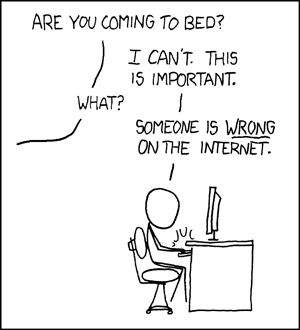
Don't think the IFT is a real problem? This week, Electronic Arts, the biggest game maker int he world, announced that they will be tying video game log ons to forum member profiles. Folks that are banned from the forums will also be blocked from logging into their games. That's right. Act like a jerk in the forum and you lose the right to play the game you purchased - and it is probably perfectly legal. Alexa reports that there are about 150 people are linked to the above comic EVERY DAY, and searching for just that single comic page brings up 13,500 hits. (That's not counting reposts, copying the image to other sites, etc.) A similar XKCD comic on the same topic:
Title: Duty Calls
Caption: "What do you want me to do? LEAVE? Then they'll keep being wrong!"
 I had internet access when I was in high school - one of about a dozen people in a large suburban school. Needless to say, the whole idea of the IFT is somehow ingrained in my psyche, as if I can't imagine the world without nutjobs causing havoc only because they can and no one knows who they are. It isn't a new concept, but it is so frequently and strongly reinforced with the advent of the web that comparing it to throwing caution to the wind on vacation because no one knows who you are in Slovenia, just isn't the same.
So, again, how does this lead to the collapse of the publication industry? It's almost a V for Vendetta scenario - an establishment continues on the usual course where one side is suppressed, the other running wild, and eventually this exact problem comes to light. Maybe it is a cancer treatment or some other research paper that leads to significant outcomes that affect a large number of people, but the word gets out that the journal 'suppressed' the finding because an IFT compliant reviewer used the journal as a proxy. I think the average non-scientist thinks that we all constantly collaborate and get along peachy, and once that facade crumbles they'll wonder what other amazing unpublished findings their tax dollars paid for.
Well, that's the grandiose version. The more realistic version is that the amount and type of feedback available from internet based communication tools will become recognized as better than any of these old timey techniques. Seriously, the current model is one step up from sending typewritten transcripts via post. Of course the journals know this, so they'll probably be the ones to spearhead new models of research review.
And the point of all this appears to be that I'm just disappointed and annoyed that the world doesn't work at my speed. :P
Enough rambling. Time to work on the SfN itinerary.
Thursday, October 16, 2008
Rockin tidbits

First, as I type, I'm watching the premier episode of Prototype This, and I gotta say I really like it so far. Check it out on Discovery Channel. As a bonus, the first episode features the Emotiv EEG BCI system. The task is to design a car that is driven by biofeedback (they started with the idea of shutting off a car in response to road rage, but it seems to be drifting towards the more fun idea of controlling the car's navigation). They also visit BioPac - which makes a number of biofeedback-related systems and sensors. Perhaps they should get one of these to add to the fun (sample video below).
The most important thing about this episode is that it highlights a concept that everyday people don't think about much, namely that any controllable signal can be translated into a computer input, and thus tied to anything a computer can control. This is a great concept to drive home for BCI enthusiasts and general hacker types. It also hits the real life issues introduced by using niche/'vertical market' devices. We know those problems all too well (and by we, I mean JDS, or as we call him "The BrainGate").
And a plane, which is the awesome-er-est:
Next, just a reminder that there are two available sites for news stories which are constantly updated .
For neuro/bci items:
http://www.google.com/reader/shared/user/12240293210094451962/state/com.google/starred
For tech items:
http://www.google.com/reader/shared/12240293210094451962
Tuesday, September 30, 2008
AWOL-ish and thoughts on experimental design
I know posts have been sparse here (the Digital Trends people haven't heard from me in months, really) but like usual, I am being overly ambitious on large projects and having to justify it while secretly plotting even larger ones.
Really, it comes down to having left the research world for 4 years, I expected some basic experiments to be completed. They're obvious, elemental, and simple, but act as cornerstones to further development. They weren't. Honestly, when I returned to academia, I didn't know what kind of project to work on and after a few talks with my advisers, it became clear that next to nothing I perceived as the logical next steps was accomplished. I actually remember the exact moment when it hit me - during a meeting when I was asking for thesis project suggestions. I recall literally stopping, staring off across the room, and thinking that either a) it was really a verify this in greater depth type of idea or b) Wow.
It isn't 'bad' - the push has been towards taking state of the art techniques and philosophies built from monkey work and applying it to the human side. Makes perfect sense. The problem is that there should always be a parallel thread building on the basic/elemental side of the equation. Working in people is different from monkeys (obviously), but the two biggest differences, and it takes some serious hammering to get them into your skull, are that you have the ability to convey concepts (not just processes) through language and you have access to unobserved processes. That means:
a) No training is needed for task familiarization (not talking procedural memory or 'mastery')
a1) Replication of monkey experiments should be performed at breakneck speed.
(Erm, unfortunate pun, but I leave it in because it correctly conveys the idea. Just noting that I did catch that.)
a2) Papers based on replicating monkey experiments require less effort (tasks already coded, expected results and caveats already mapped) and report less significant findings (i.e. - they become "Worked in monkeys. Yup, works in people." comparative studies).
a3) Should require either a novel functional outcome ("We can therefore do X with a BCI.") or provide insight on a monkey-impossible phenomenon ("Think about grandma's apple pie while you do X.").
b) Almost any experience once relegated to the world of 'cognitive neuroscience' becomes admissible. I know what it means to "recall the scent of a new car", so do you. Most of us do. There might be significant variance in what that scent actually is, but in understanding 'the brain's response to imagined new car smell', we all know the subject/object of reference. Take out these accepted experiential elements because of the artificial distinction in neuroscience sub-fields, and I would argue that ascribing any neural activity to any unobserved process (preparation, reward, saliency, etc.) must be eliminated, too. Sorry, no ascribing unobserved forces to activity, since you have no ability to say with complete certainty that monkeys operate in a conceptual/cognitive manner similar to humans. You're just anthropomorphizing mental or neural processes based on statistically significant relationships in a constrained environment, and you're dissociating environmental cues, not internal representations. Does that colony of monkeys happen to be full of synaesthetes? How many times do you hear, "Yeah, the monkey just didn't want to work today"? Or, "Yeah, the monkey got bored."? So, the data is collected only when the monkey "wants" to work?
So, in short, human BCI experiments should incorporate 'cognitive neuroscience' techniques in order to enrich the functional/translatable significance of the outcomes. I love to use the example of crossing the street. A BCI user should be able to recall crossing streets, imagine crossing the street in front of them, tell a joke about a particular chicken crossing a street, point across the street, and want to get to the other side of the street without stepping into traffic. Otherwise, we're doomed to becoming glorious reflex arcs.
(And for extra credit, imagine a world in which Sartrian angst is always acted on. Scary.)
Anyhow, I think that the state-of-the-art and elemental streams need to always be examined in parallel (even better in concert, but tougher to design and control). And, having already spent too much time typing this, I'll leave to you to consider why that is (hint: there are practical, moral, and theoretical reasons). Enjoy the brain twisting. :D
Really, it comes down to having left the research world for 4 years, I expected some basic experiments to be completed. They're obvious, elemental, and simple, but act as cornerstones to further development. They weren't. Honestly, when I returned to academia, I didn't know what kind of project to work on and after a few talks with my advisers, it became clear that next to nothing I perceived as the logical next steps was accomplished. I actually remember the exact moment when it hit me - during a meeting when I was asking for thesis project suggestions. I recall literally stopping, staring off across the room, and thinking that either a) it was really a verify this in greater depth type of idea or b) Wow.
It isn't 'bad' - the push has been towards taking state of the art techniques and philosophies built from monkey work and applying it to the human side. Makes perfect sense. The problem is that there should always be a parallel thread building on the basic/elemental side of the equation. Working in people is different from monkeys (obviously), but the two biggest differences, and it takes some serious hammering to get them into your skull, are that you have the ability to convey concepts (not just processes) through language and you have access to unobserved processes. That means:
a) No training is needed for task familiarization (not talking procedural memory or 'mastery')
a1) Replication of monkey experiments should be performed at breakneck speed.
(Erm, unfortunate pun, but I leave it in because it correctly conveys the idea. Just noting that I did catch that.)
a2) Papers based on replicating monkey experiments require less effort (tasks already coded, expected results and caveats already mapped) and report less significant findings (i.e. - they become "Worked in monkeys. Yup, works in people." comparative studies).
a3) Should require either a novel functional outcome ("We can therefore do X with a BCI.") or provide insight on a monkey-impossible phenomenon ("Think about grandma's apple pie while you do X.").
b) Almost any experience once relegated to the world of 'cognitive neuroscience' becomes admissible. I know what it means to "recall the scent of a new car", so do you. Most of us do. There might be significant variance in what that scent actually is, but in understanding 'the brain's response to imagined new car smell', we all know the subject/object of reference. Take out these accepted experiential elements because of the artificial distinction in neuroscience sub-fields, and I would argue that ascribing any neural activity to any unobserved process (preparation, reward, saliency, etc.) must be eliminated, too. Sorry, no ascribing unobserved forces to activity, since you have no ability to say with complete certainty that monkeys operate in a conceptual/cognitive manner similar to humans. You're just anthropomorphizing mental or neural processes based on statistically significant relationships in a constrained environment, and you're dissociating environmental cues, not internal representations. Does that colony of monkeys happen to be full of synaesthetes? How many times do you hear, "Yeah, the monkey just didn't want to work today"? Or, "Yeah, the monkey got bored."? So, the data is collected only when the monkey "wants" to work?
So, in short, human BCI experiments should incorporate 'cognitive neuroscience' techniques in order to enrich the functional/translatable significance of the outcomes. I love to use the example of crossing the street. A BCI user should be able to recall crossing streets, imagine crossing the street in front of them, tell a joke about a particular chicken crossing a street, point across the street, and want to get to the other side of the street without stepping into traffic. Otherwise, we're doomed to becoming glorious reflex arcs.
(And for extra credit, imagine a world in which Sartrian angst is always acted on. Scary.)
Anyhow, I think that the state-of-the-art and elemental streams need to always be examined in parallel (even better in concert, but tougher to design and control). And, having already spent too much time typing this, I'll leave to you to consider why that is (hint: there are practical, moral, and theoretical reasons). Enjoy the brain twisting. :D
Thursday, August 21, 2008
Few more interesting items
I know, I'm being bad about content. I swear I'll be back on track as soon as this prelim thing is done, which can be measured in days now (hopefully).
Thanks to good ole MetaFilter, I now have a favorite site for highly relevant research papers on PubMed. And by relevant I mean bat-shit crazy. I give you *giggle* A Good Poop.
Yeah yeah, we've seen attempts at overcoming the "Uncanny Valley", so why does this lady keep rambling on about their... wow... wait a sec... that's not a real person. (Site for the company with another demo.)
And Switched has a blurb on whether/how computer use is changing the development of our brains from childhood through adulthood (citing a BBC story). They note the increase in Ritalin prescriptions and ADHD diagnoses as proof that something is going on. Really? I mean why would children develop ADHD when their daily routine consists of TV while playing a computer game, while chatting in the game and instant messenger, unless they get a SMS or phone call, possibly a Skype call, too, with a tabbed browser open, along with email, a music program, maybe a download client, and a homework assignment? Meh, face it. If your kid has ADHD they're at an advantage. Just teach them how to make use of it and they'll turn out fine. Look at me! I'm borderline, and I'm normal as can be. Oops! 6:00pm! Gotta thaw another dead squirrel in the basement freezer so I have something to swat the invisible dragons with! (Quietly mumbling: they're coming to take me away haha, they're coming to take me away hoho...)
Thanks to good ole MetaFilter, I now have a favorite site for highly relevant research papers on PubMed. And by relevant I mean bat-shit crazy. I give you *giggle* A Good Poop.
Yeah yeah, we've seen attempts at overcoming the "Uncanny Valley", so why does this lady keep rambling on about their... wow... wait a sec... that's not a real person. (Site for the company with another demo.)
And Switched has a blurb on whether/how computer use is changing the development of our brains from childhood through adulthood (citing a BBC story). They note the increase in Ritalin prescriptions and ADHD diagnoses as proof that something is going on. Really? I mean why would children develop ADHD when their daily routine consists of TV while playing a computer game, while chatting in the game and instant messenger, unless they get a SMS or phone call, possibly a Skype call, too, with a tabbed browser open, along with email, a music program, maybe a download client, and a homework assignment? Meh, face it. If your kid has ADHD they're at an advantage. Just teach them how to make use of it and they'll turn out fine. Look at me! I'm borderline, and I'm normal as can be. Oops! 6:00pm! Gotta thaw another dead squirrel in the basement freezer so I have something to swat the invisible dragons with! (Quietly mumbling: they're coming to take me away haha, they're coming to take me away hoho...)
Wednesday, August 13, 2008
Two quickies
First, following on yesterday's rambling post, I've had a chance to very briefly skim "Scholarship in the Digital Age: Information, Infrastructure, and the Internet" by Christine Borgman. If you're into those sorts of issues, it is a pretty nice place to start. It doesn't quite play the "Ah ha!" type of changes that change the game entirely, but presents the problems that will be encountered by slow, methodical changes.
Next, congrats to Ethan (one of our "NIH kids") for his work on new review of reward systems! Ethan is a great teacher, and I expect a hydrocephalic hamster could walk away from this paper with a complete understanding of the topic.
New insights on the subcortical representation of reward
Hikosaka O, Bromberg-Martin E, Hong S, Matsumoto M.
Curr Opin Neurobiol. 2008 Jul 29. [Epub ahead of print]
Next, congrats to Ethan (one of our "NIH kids") for his work on new review of reward systems! Ethan is a great teacher, and I expect a hydrocephalic hamster could walk away from this paper with a complete understanding of the topic.
New insights on the subcortical representation of reward
Hikosaka O, Bromberg-Martin E, Hong S, Matsumoto M.
Curr Opin Neurobiol. 2008 Jul 29. [Epub ahead of print]
Welcome to Consumerism 2.0: No idea what we're doing

(Note: After writing I realized this was much more rambling than intended, but, meh, enjoy the stream of consciousness.)
Techdirt has an interesting blurb on the idea sure to make any transhuman giggle with glee and Kurzweil smile with approval. The article posits that planned obsolescence is dead. Apple was probably the last to really make a go with it using redesigned computer cases, a la iMac, but tech moves too fast and we live in a global market, making exposure and availability non-issues in product design. Also, any real improvements in the overarching technology is announced far enough ahead of time so that OEMs can queue up to the the first to offer them, and competition is very much alive and well, leading companies to show their cards as soon as they have reasonable certainty that the products or services are feasible.
Anyhow, it's an interesting point to consider. I don't think the issue is that tech development or discoveries are happening too fast for the market, I think the nature of the markets and the complexity of 'reference' products (ie - instead of traditional metrics like crop harvest, we've added PC sales, cell phone subscribers, etc to the mix) has fundamentally changed. Hell, look at HDTV. Market penetration is just starting to hit a level of real significance, and even with that, how many people that you know of have a Blu-Ray player? How many HD channels are there on your TV? Undoubtedly a large part of this slowness to adopt is due to outdated business models making their last stand (eg - RIAA and MPAA) or crazy departures from traditional models with hopes of hitting the right plan (eg - the Internet bubble burst of 2001).
Maybe it is that the nature of the Internet is more Socialist than Capitalist. Maybe information itself is like this, or human social tendencies. People try to peg down what makes modern culture such a departure from the past, and they all seem to converge at 'faster communication'. True, but you can't ignore that communication rarely stops at any one receiver - it propagates through the system/society. I guess what I mean is that there is no grape vine anymore, just a series of babbling guys and gals with megaphones.
So, why is this on a BCI blog (yes, I know I've been wandering anyways lately, but there is a point)? Because BCI design requires traditional tech, which moves by the above mentioned mysterious means, and basic science, which has not fully embraced this new paradigm. Academia as a whole hasn't, and the approach to a product's design versus understanding the underlying nature of it are in complete discord. What's more, initiatives like the NIH's push for translational research over basic science don't help. At best they take scientists uncomfortable with the idea of making use of findings and slowly nudge them to thing of practical applications, but what it really means is a nice rewrite of their grant's intro and discussion.
To make matters even more difficult, the academic market in science is nearly uncustomizable - what works for molecular biology doesn't for engineering. Who in their right mind would develop a product to be used by 15 labs? Sure you could charge through the nose, but eventually, you'll lose out to budget concerns or lack of manpower to implement the one new feature that 4 of those 15 labs are requesting. Try to get things rolling with a big company and wait for cries of Big Corporation sullying the good name of academia. Try to get a more science oriented company to take on a problem and you get EndNote. Sure you CAN use EndNote for keeping track of publications, but that has got to be the most obnoxiously buggy, overpriced, and generally annoying program I've ever been forced to use. I fricken HATE EndNote. But it isn't all Thompson's fault - why the Hell do we still care about publications? Are we still at the point where we need magazines to tell us what is hot is science for the Fall Season? Oh, and how many other publications are there out there where YOU pay the PUBLISHER for accepting your content, once reviewed by others? "We're not even sure this is very good, so we'll send it to some other people in your field. We won't pay them, bu they will tell us if it is worthy, and then maybe you can pay us a couple thousand dollars, and we'll add it to the magazine we make a profit off of." None, and publishing in every profession serves the same purpose - career advancement/recognition. (I'll give J of Neuroscience a pass, since it funds a society that supports meetings, but it is still a ridiculous model.)
I'm starting to get off topic here, but the idea in general is that basic science needs a revolution in the way it is harnessed, supported, and integrated into companies or collaborations between researchers and companies. Basic science negates the possibility of planned obsolescence by its very nature, and the technologies that support it do as well. The result has been many smaller companies with highly specialized products at high prices. That's why I predict that BCI development will remain the territory of small, highly specialized companies. Regardless of what the numbers say about the number of people that can use one, the pace of development is set by basic science, not mass market technology, which incurs high costs for low material gains. It is a Lose-Lose model right now because no one knows how to push research into the next major phase that I think all researchers know they are on the cusp of, nor do we know how to operate a traditional company in the modern/connected world (at least, not responsibly). Most people assume that you develop a device, some magic occurs, and you are off and running a business, but that is becoming less and less the case.
Don't get me wrong - there are plenty of chances to spin science into a viable company that makes a few people rich and a bunch happily employed. But, the chances that it will change the world are slim to none because the means simply aren't there. As the death of planned obsolescence has pulled some of the old tricks of product design out from under the businesses that relied on it, science based business has suffered from stagnation, which may be a boon. Rather than scramble reactively, we're thinking of ways to push past overspecialization. And I know just how we'll do it... but you'll have to subscribe to DirectNeuralInterface v2 for the low low monthly rate of just $2000 to find out ;)
Thursday, August 7, 2008
Book rec

For all you sciencey types, I thought I would share a little gem. I have what may be the best 'bathroom reader' for geeks. Eurekas and Euphorias by Walter Gratzer (ISBN: 0198-60940-X) is a great collection of short tales covering the antics, personalities, and accidental discoveries in the traditional scientific fields (physics, biology, chemistry). Each 1 to 5 page story is like a peek into the lab of a Nobel Laureate in another time. The ridiculously inflated language serves the book greatly, as most of the tales come from times when formal writing was prevalent, making the reader feel even more 'in' on the joke.
Grab a copy! You'll love it. (Prices)
Tuesday, June 3, 2008
Hallelujah transhumanism!

Alright, I like pontificating on the future as much as other people, but really, tranhumanist types, the singularity stuff is getting too much attention and damaging legitimate attempts at more 'humble' science. I got thinking about this after reading the title of this Neurophilosophy post ("The Technological Rapture"). Isn't that what it is? Just another substitute for religion, but with nanobots and bytes instead of angels and miracles?
Yeah, it is, just with a more physical/material slant. Technology/God will come and sweep away the chosen ones that embrace it/him! Into a land of pure energy/spirit and knowledge/love! Those that choose to ignore progress/the lord will be left behind as the Earth is destroyed by man made disaster/demons or catastrophic solar event/rivers of blood and whatever!
What separates the two is the semi-feasibility of approaching a 'singularity' point where knowledge progresses faster than we can perceive it. Problem is... that happens NOW. 20% of the US has never sent an email. You have to pull your head out of math and science, and submerge it into sociology and philosophy a little here, kids. Or, if you need an equation/variable as a mental speed bump, how about this: Progress requires that the perceiver/creator both acquire knowledge and act on it (whether thinking/building/etc) in order to influence other perceivers/creators. Evolution dictates that organisms will act to increase fitness, therefore use of the aforementioned knowledge will be used to aid the individual with it. If speed of advancement is infinite, then the population instantaneously is cleaved to a single person/creator/etc with infinite lifespan (that kookie 'god moment' type thing). Any semi-intelligent person, say Mr #2 to Mr #1 above, would realize this and destroy Mr#1 in order to stay alive, as Mr#3 would gank Mr#2. The whole process converges to a "Mediocrilarity" where advancement cannot be faster than acting on it because the 'progressors' are held at some type of equilibrium point others can comprehend. Tada! Stalemate.
So, stop talking about brain implants like they'll be used to control planet-seized sentient robots that can time travel and fight angels with dark matter. It makes getting funding harder when everyone with a normal 9-5 job thinks you're wacko.
(Here are those recent articles on this. (shame on IEEE Spectrum for hosting this.))
Sunday, April 13, 2008
List o' lists
So, this week I'll point you to the best of the best of what others thought were list worthy. Good, bad, brain related, tech related, insanity related; they're all here. Enjoy!
- Top viral videos of 2007
- Top unsolved mysteries of the brain
- Top 10 Neuroscience trends of 2007
- Top 50 Top 10 lists of 2007
- Top things you can do to become posthuman
- Top 10 craziest science experiments
- Top shocking science depicted in film
- Top 5 recreational drug experiments
- Top flaws found in famous psychology experiments
- And lastly, the top 50 comedy sketches of all time
Adding a few more here...
- Top 10 impossibilities conquered by science
- Top mind bogglingly inaccurate science movies
- Top 10 futuristic materials
- Top 9 idioms that come from technology
- Top 15 movies you didn't know were science fiction
- Top viral videos of 2007
- Top unsolved mysteries of the brain
- Top 10 Neuroscience trends of 2007
- Top 50 Top 10 lists of 2007
- Top things you can do to become posthuman
- Top 10 craziest science experiments
- Top shocking science depicted in film
- Top 5 recreational drug experiments
- Top flaws found in famous psychology experiments
- And lastly, the top 50 comedy sketches of all time
Adding a few more here...
- Top 10 impossibilities conquered by science
- Top mind bogglingly inaccurate science movies
- Top 10 futuristic materials
- Top 9 idioms that come from technology
- Top 15 movies you didn't know were science fiction
Thursday, January 17, 2008
Running with the story

The speculation was right. Looks like Oscar Pistorius is too fast for the Olympics. I wonder what would have happened if he had not tried as hard. You know, hold back a little, maybe throw a race or two. Then blow everyone out of the water at the Olympics. That would be awesome to watch.
[Wired props]
Anyhow, The Onion has their take on it. (Highly recommended.)
Tuesday, January 15, 2008
Science and Society

Two articles worth noting for all scientists.
Oh science and religion. Will you two ever get along? A speech by the Pope is being protested in Italy by the scientific community there due to comments made about Galileo's trial by the church. Wired has the scoop.
And a little closer to home, and MUCH overdue idea may finally be realized. There is a push for a science related debate among presidential candidates in the US elections. Holy crap! What can politicians say when they are forced to use actual facts? There is a major downside to this, though. If this debate becomes a mainstay, the politicization of science will be in full effect. In other words, right now both parties site a statistic and toss a softball at the opposing party, usually in the form on some minor factoid. If things move in this direction, we're talking a concerted effort by special interest groups to skew data. On top of that, by politicizing science, science itself becomes less trusted in the public's eyes, which means more troubles with funding and policy decisions. Do we really want people thinking, "Oh, I would agree with this finding, but I know you're in the pocket of Big Tectonics, so I assume there is an agenda here." Either way, I'm excited that this might go forward THIS YEAR. Again, Wired has the 411.
Saturday, January 5, 2008
New senses

OMG I feel like this cold is going to kill me. Ugh.
Anyhow, bitching aside, Reddit caught what I am assuming is actually an older article on Wired on the idea of adding new senses by harnessing plasticity. Let's set aside the idea that all our more primitive portions of neural gooeyness are not designed to just lump new senses on top of old ones, what would be considered a "new sense"?
Some eels can detect distortions in a self generated electromagnetic field around their bodies, but that's all I can really think of off hand. Generally, there is a very basic fallacy that all these articles miss: transducing one phenomena into another sense violates the idea of bringing into existence a new sense. In other words, like in this article, adding vibrotactile pads to indicate the distance above the ground (by vibration frequency) is not really "sensing" gravity. You're sensing vibrational frequency. If you lose the ability to detect haptic feedback, you lose your "gravity" sense. The same is not true of our other senses. But, to play Devil's advocate, at a base level everything is transformed into nerve impulses. And yet, to play the Devil's Devil's advocate (I swear that's the title of a heavy metal song), each of our senses as its own wiring that is oodles more complicated than "sensation A is detected by cell type A, and then that just goes to 'the brain'".
Anyhow, a similar self-mutilation type version was discussed earlier on DNI, and the article links to the writer's blog, which is decent, though not updated very often. Worthy of an RSS sub at least.
Thursday, December 27, 2007
All your research are belong to us!
I was going to mention this earlier (I think I have another link buried somewhere in my rss reader), but the US congress has just passed a bill requiring that all NIH funded research-based publications be made available on PubMed one year after publication. This is great news. I know that while I was out of academia, I found it almost impossible to keep up with the research world, since I couldn't access any journals.
Brought to my attention again by Slashdot.
Brought to my attention again by Slashdot.
Saturday, December 22, 2007
Sunday, October 14, 2007
Bits and pieces/bytes/boutons

With my SfN poster needing to be done this week, I've had little time to post (one of the joys of working with a company that needs to approve disclosures is that unlike everyone else who will be cramming to complete their posters in two weeks, I get to do that cramming two weeks early).
Anyhow, TechRivet has a little ditty on The Singularity worth reading if you are unfamiliar with what that is. Essentially, one of the edicts of transhumanism is that human progress will reach a point where we can no longer accurately predict the next major advancement because breakthroughs will occur continuously. I was all about the Extropianism when I was in high school, but I guess years of academic indoctrination (read: how the world actually works in a practical and realistic manner) has washed that from me, mostly.
For instance, yes the breakthroughs in genetics have been increasing, but the complexity of the breakthroughs and the number of people/resources needed to accomplish these breakthroughs is increasing MORE rapidly. Intellect needed to perform the research and devise the experiments is NOT infinite, and there are easy to recognize speed bumps on the horizon (e.g.-Moore's Law will not hold up forever, biology still moves at the speed of biology - you don't study development waiting for something to develop, reactions take time, and time cannot be ignored, etc).
Anyhow, if it is something of interest, whether as inspiration or amusement, go ahead and check out the Extropy Institute (Wikipedia overview) or Ander's Transhumanism Page (one of the ORIGINAL originals from 'way' back in the early 90's).
Monday, August 6, 2007
When will science catch up with the Web?

It seems that we've had an explosion in the tools for collaborative work in programming projects, social interaction, and general resource management over the past 5 years thanks to the Web. So, why is it that science seems to be stuck back in 1993? Sure, collaboration via email, messengers, and Skype is on the rise, but where's the truly USEFUL implementations of internet technology. Ignoring the fact that 99.9% of all science department websites barely scrape by with HTML 1.0 specifications, where's the ingenuity? (I would like to point you to OUR department website - be prepared to laugh and be horrified at the same time. You've been warned!)
Sure, we can grab papers a little quicker, and there's distributed computing, but most of that is old hat, and barely a step up from 1980's clusters and Xerox machines.
The closest thing I've seen recently has been NeuroCommons - a component of Science Commons. The general idea is based around the idea of Creative Commons, a copyright method that currently fits the internet model for the publishing, display and use of original materials. This is not a niche phenomenon - heavyweights like Flickr (owned by Yahoo!) and Blogger (owned by Google) are among the companies on board.
Part of the problem is obviously recognition. New systems of copyright have yet to be really tested for how well they will hold up in court, and the impact of recognition for CC work has really yet to be seen. I think everyone is frantically trying to be the next Einstein - that lone scientific figure that makes a huge breakthrough. The more you share, the more of the limelight you lose. Add to that the issue of funding, and it's no wonder copyright/researchright schemes fail. No doubt an international free market approach to translational research would solve many of these issues (you make the discovery leading to a medication, you get part of the profit), but that leaves basic science as the bastard child of rest of research.
I have some ideas that I'm mulling over in my head right now. I like shocking the system. I don't want to share them just yet, but if I decide against my little 'plan', I'll put it out there for others to consider. There are legal reasons that this idea would not be feasible, and I'm not THAT nuts, nor do I want to jeopardize the work of others. I'll talk with some people, get some feedback, and see if it is feasible.
PopSci has a nice overview of the copyrighting idea for the uninitiated.
Subscribe to:
Posts (Atom)