Here are a few stories worth noting from the last few weeks along with some random ramblings.
Now you see it, now you don't (remember)!
First, I'm watching a really interesting piece from 60 minutes on how flawed eyewitness testimony can be. What's most interesting is the way that psychologists can alter the report of an eyewitness in a predictable manner. To sum up one technique, present two faces that are similar to the perpetrator, present the previously chosen face and another that is very different, present the reaffirmed face and the perpetrator. These little psychological tricks provide important clues to the inner workings of memory and an important bridge between experimental and applied psychology. Whether they will be equally useful for neuroscience, we'll have to wait and see. Think of these types of stories as similar to the barrage of visual illusions you would see in an intro to neuroscience course (like these). Part 1 sets up the case, Part 2 is where it gets interesting (those pressed for time can skip to part 2).
Eat it ASIMO!
Toyota has been trumpeting the creation of a noninvasive BCI (EEG) for controlling a wheelchair. Basically, it sounds like a 3 state decoder (forward, left, right), with an emergency stop signal (the user puffs out their cheek). Usually this isn't too exciting (like that Honda media circus the previous month), but the 125ms lag is actually pretty good for EEG. Worth looking into more for those even slightly interested in EEG based systems.
Mendeley-he-hoo!
v0.9 (and now v0.9.1 which fixes a problem with PDF linking), is now available. PDF reader with annotation tools, more control over syncing collections, and a bunch of other features. Go get em, tiger!
Showing posts with label neuroscience. Show all posts
Showing posts with label neuroscience. Show all posts
Friday, July 17, 2009

Wednesday, June 10, 2009
BrainGate2 clinical trial is go

That's right! Everyone's favorite Neural Interface System, filled to the brim with Brain-Computer Interfaceyness, BrainGate, is continuing clinical trials, sans Cyberkinetics. Massachusetts General Hospital will serve as the home base, with close ties to Brown and Harvard universities and the Providence VA Hospital. Leigh Hochberg takes the helm as PI and lead investigator along with John Donoghue. The project is being called BrainGate2 in part to denote advancement in the systems, techniques and understanding used in designing and implementing an NIS. People looking for more information, including participant enrollment, can check out the below links and Braingate2.org.
Clinical trials page on BrainGate2.org website
ClinicalTrials.gov entry
Brown University release
GenEngNews article
Boston Globe article
Providence Journal article
PhysOrg article
Reddit catch
Twitter catches
Friday, March 27, 2009
EEG consumer BCIs spanked by the Schwartzinator
Forbes has a fun little story on the state of consumer BCIs that hits on the major consumer players, but also throws real BCIs researchers John Wolpaw and Andy Schwartz into the fray. Each echos the officially sanctioned position of their respective scalp electrode versus implanted microwire/fancier probe electrode camp.
I prefer to call this the Head-Computer Interface versus Brain-Computer Interface debate. I try to be even keeled on the subject. EEG is obviously a worthwhile endeavor because there's none of that messy surgery involved, and thus appeals to a very large audience (at least in the near term). Hey, if you get a signal that can be controlled by the user reliably and with an acceptable level of precision, you have something useful. BUT, EEG is a degraded, garbled, sloppy signal prone to nearly limitless interference sources. Anything that can bork an implanted BCI can bork an EEG-based system, but EEG throws the doors open to the world because you are essentially wearing an antenna (or several).
One major problem with EEG is the fallacy that somehow destroyed information can be recovered by some form of fancy filtering. This is simply not so. Think of the electrode as a point of convergence for all electromagnetic signals of a measurable intensity. Even after narrowing frequency bands and implementing funky probabilistic decoders, any squiggle can be the convergence of several squiggles of indeterminable sources. In other words, at a specific time, a signal of amplitude +5 can be two signals of +4 and +1, -2 and +7, or 5 signals of +1-4-2+3+7. And don't even start with harmonics.
The second problem is population size. I know we like to think that motor cortex responds to only movement. It makes life easier. What life? Life in La-La-Land. MI responds to visual stimuli, movement preparation, auditory stimuli, imagined movements, movement related words (heard, internally rehearsed or spoken), reward, attention, cutaneous and proprioceptive feedback, and a bunch of other factors I'm not even mentioning. Until the impact of these influences is understood and quantified, there will not be any BCI that translates the neural activity for "move my arm to point x,y,z". EEG will never have the fidelity to isolate the differences feedback has at the single neuron level, so the nature of the recorded signal will never allow the 'direct' mapping of neural activity to output. That is, the activity that once gave rise to movement can never be harnessed with an acceptable degree of control to recreate the movement. Yes, I am using the word never. Never. There, I said it again.
Like I said, this isn't an attack on EEG, just reality. Different uses for different technologies. I can drive a car on a road. That doesn't mean I can drive a road, or that a road has no use.
I prefer to call this the Head-Computer Interface versus Brain-Computer Interface debate. I try to be even keeled on the subject. EEG is obviously a worthwhile endeavor because there's none of that messy surgery involved, and thus appeals to a very large audience (at least in the near term). Hey, if you get a signal that can be controlled by the user reliably and with an acceptable level of precision, you have something useful. BUT, EEG is a degraded, garbled, sloppy signal prone to nearly limitless interference sources. Anything that can bork an implanted BCI can bork an EEG-based system, but EEG throws the doors open to the world because you are essentially wearing an antenna (or several).
One major problem with EEG is the fallacy that somehow destroyed information can be recovered by some form of fancy filtering. This is simply not so. Think of the electrode as a point of convergence for all electromagnetic signals of a measurable intensity. Even after narrowing frequency bands and implementing funky probabilistic decoders, any squiggle can be the convergence of several squiggles of indeterminable sources. In other words, at a specific time, a signal of amplitude +5 can be two signals of +4 and +1, -2 and +7, or 5 signals of +1-4-2+3+7. And don't even start with harmonics.
The second problem is population size. I know we like to think that motor cortex responds to only movement. It makes life easier. What life? Life in La-La-Land. MI responds to visual stimuli, movement preparation, auditory stimuli, imagined movements, movement related words (heard, internally rehearsed or spoken), reward, attention, cutaneous and proprioceptive feedback, and a bunch of other factors I'm not even mentioning. Until the impact of these influences is understood and quantified, there will not be any BCI that translates the neural activity for "move my arm to point x,y,z". EEG will never have the fidelity to isolate the differences feedback has at the single neuron level, so the nature of the recorded signal will never allow the 'direct' mapping of neural activity to output. That is, the activity that once gave rise to movement can never be harnessed with an acceptable degree of control to recreate the movement. Yes, I am using the word never. Never. There, I said it again.
Like I said, this isn't an attack on EEG, just reality. Different uses for different technologies. I can drive a car on a road. That doesn't mean I can drive a road, or that a road has no use.
Thursday, September 18, 2008
Hochberg article in NEJoM
Leigh has an article in this month's New England Journal of Medicine related to The Project. Required reading, of course.
Wednesday, July 9, 2008
Cortical map desktop images released!
Looks like the interweb deities are smiling on us. As far as I can tell, I can post these without fear of losing my sweet, sweet grad student paycheck to the copyright cops.
I uploaded a new archive, though, which includes a text file that gives attribution to the authors and journal just in case the url gets passed around and people don't get it from here. No password needed.
Here it is:
http://rapidshare.com/files/128403736/Brain_map_desktop_pics_5120x1200.zip.html
Enjoy!
I uploaded a new archive, though, which includes a text file that gives attribution to the authors and journal just in case the url gets passed around and people don't get it from here. No password needed.
Here it is:
http://rapidshare.com/files/128403736/Brain_map_desktop_pics_5120x1200.zip.html
Enjoy!
Tuesday, July 8, 2008
Wallpaper maps uh-huh


An awesome awesome awesome paper in PLoS Biology that has been getting media attention lately made a valiant attempt to map the brain. Yeah, the whole thing (okay, just cortex). Using Diffuse Spectrum MRI, the researchers constructed an ROI-based network of nodes, between which normalized strength measurements were calculated. No, I'm not sure how they did it exactly (I've only had time to skim the paper), nor could I find what task the people were asked to perform. They may have just asked them to lie there and taken any spontaneous activation, but that would be horribly uncontrolled.
The results point to distinct hubs:
"Based on their aggregated ranking scores across six network measures (Table 1), we identified eight anatomical subregions as members of the structural core. These are the posterior cingulate cortex, the precuneus, the cuneus, the paracentral lobule, the isthmus of the cingulate, the banks of the superior temporal sulcus, and the inferior and superior parietal cortex, all of them in both hemispheres."Check out the paper. (Free to everyone)
I like it so much I made a new desktop background from the images (thumbnails above). Three monitors of cortical map glory!
I have not contacted the authors to see if it is okay for me to post the full size images, but will as soon as I post this. The paper is Creative Commons with no permissions needed, but I like to play it safe.
The zip containing the images is hosted here, but I've passworded it until I get the go ahead from Hagmann et al. And the real images at full size are much much nicer. Remeber that these are probably larger than you need (5120x1200 = 2x 20" 4:3 monitors + 1x 24" 16:9 monitor), so scale and crop accordingly.
Wednesday, May 28, 2008
Monkey self feeding BCI control
Alright, I get it. Several people have sent along links to Andy Schwartz's Nature publication, so here's the info. Thanks to Remy Wahnoun and Natalia "Get Moose and Squirrel" Bilenko for doing my work for me and compiling the links, and being the first to send info along.
http://www.nature.com/nature/journal/vaop/ncurrent/full/nature06996.html
http://news.bbc.co.uk/2/hi/science/nature/7423184.stm
http://technology.newscientist.com/channel/tech/dn14000-robomonkeys-use-brain-power-to-grab-a-bite.html?feedId=online-news_rss20
The work reported involves real time decoding to drive a robot arm, which fed the monkey. I haven't had time to run through the whole thing, so here's the "shoot from the hip" version of my thoughts. I'll update these
Interesting points:
- The monkey was trained to use the arm with a joystick, and followed by, the part I thought was very interesting, various levels of pre-programmed control assistance while using brain signals. I will expand on this later, but it is an interesting task design for several reasons.
- Having seen some of the raw video at the Neurobotics 2007 workshop, there is much more obviously correlated arm motion. They have an entire, substantial paragraph devoted to this, since they probably knew it would be a criticism.
The three points they make are:
1) Movements were with the arm ipsilateral to the electrodes.
2) The movements were delayed by up to a second.
3) Moving is required, since BCI control has been demonstrated before without it.
They cite some supplementary info and write, "... monkey’s hand movement was only loosely coupled to prosthetic control." The video I saw before tells a slightly different story. There was a pulling movement 100% of the time (every trial), and when the arm didn't reach the monkey's mouth it would 'paw' or 'dig' (repeated movements similar to pulling an invisible object toward the body) repeatedly until the arm reached the monkey's mouth. You can see this pretty clearly in the video linked above (watch the hand in the plexiglass tube). Yes, there is a delay, but the whole situation would be interesting to examine. It may not require the 'pulling' at onset, but monkeys very often use both hands to eat. Those of you with monkeys, go give them a treat. They will grab it with they right hand (usually), and then pull it towards their body and engage their left hand as they do so. Feeding it almost always a bimanual task for macaques, explaining the ipsilateral activation and the delay. Reason #3 above is kind of a brush off reason - hey, movement is needed to use a BCI, so no big deal. The three cited papers are all in humans, all were tetraplegic, all lacked some degree of propriocentive feedback, two didn't use PVA or multielectrode arrays, none used an arm, none had confirmed the lack of covert movements with EMG, and the list goes on.
- The trial was very organic and continuous, which is great. From my brief skimming, it looks like simultaneous control of the hand aperture needed to be maintained throughout the task, hinted at when they observe the the hand slowly opening along the path to the food.
In general this is a nice, brief summary with some very interesting points (perfect for a Nature Letter). Obviously they are preparing some studies, and this was released to wet out appetites. The 'organic' nature of the task will open it up to many criticisms, but more studies like this are needed in order to understand the dynamics in play when dealing with a experiences that lack built-in boundaries and environmental awareness. Definitely good thought fodder.
http://www.nature.com/nature/journal/vaop/ncurrent/full/nature06996.html
http://news.bbc.co.uk/2/hi/science/nature/7423184.stm
http://technology.newscientist.com/channel/tech/dn14000-robomonkeys-use-brain-power-to-grab-a-bite.html?feedId=online-news_rss20
The work reported involves real time decoding to drive a robot arm, which fed the monkey. I haven't had time to run through the whole thing, so here's the "shoot from the hip" version of my thoughts. I'll update these
Interesting points:
- The monkey was trained to use the arm with a joystick, and followed by, the part I thought was very interesting, various levels of pre-programmed control assistance while using brain signals. I will expand on this later, but it is an interesting task design for several reasons.
- Having seen some of the raw video at the Neurobotics 2007 workshop, there is much more obviously correlated arm motion. They have an entire, substantial paragraph devoted to this, since they probably knew it would be a criticism.
The three points they make are:
1) Movements were with the arm ipsilateral to the electrodes.
2) The movements were delayed by up to a second.
3) Moving is required, since BCI control has been demonstrated before without it.
They cite some supplementary info and write, "... monkey’s hand movement was only loosely coupled to prosthetic control." The video I saw before tells a slightly different story. There was a pulling movement 100% of the time (every trial), and when the arm didn't reach the monkey's mouth it would 'paw' or 'dig' (repeated movements similar to pulling an invisible object toward the body) repeatedly until the arm reached the monkey's mouth. You can see this pretty clearly in the video linked above (watch the hand in the plexiglass tube). Yes, there is a delay, but the whole situation would be interesting to examine. It may not require the 'pulling' at onset, but monkeys very often use both hands to eat. Those of you with monkeys, go give them a treat. They will grab it with they right hand (usually), and then pull it towards their body and engage their left hand as they do so. Feeding it almost always a bimanual task for macaques, explaining the ipsilateral activation and the delay. Reason #3 above is kind of a brush off reason - hey, movement is needed to use a BCI, so no big deal. The three cited papers are all in humans, all were tetraplegic, all lacked some degree of propriocentive feedback, two didn't use PVA or multielectrode arrays, none used an arm, none had confirmed the lack of covert movements with EMG, and the list goes on.
- The trial was very organic and continuous, which is great. From my brief skimming, it looks like simultaneous control of the hand aperture needed to be maintained throughout the task, hinted at when they observe the the hand slowly opening along the path to the food.
In general this is a nice, brief summary with some very interesting points (perfect for a Nature Letter). Obviously they are preparing some studies, and this was released to wet out appetites. The 'organic' nature of the task will open it up to many criticisms, but more studies like this are needed in order to understand the dynamics in play when dealing with a experiences that lack built-in boundaries and environmental awareness. Definitely good thought fodder.
Wednesday, May 14, 2008
Death to the spike sorters!
First, good paper here: Spike train decoding without spike sorting by Ventura, V. (also available free on her site here)
Essentially, she looks at using a simple voltage thresholding of the continuous data stream to infer neuron identities using a very complicated process of turning curve fitting and statistics. One of the more interesting things, I thought, was the way in which noise drops out of the equation, since "noise" is all allocated to a "noise neuron". I am just looking at the paper for the first time, but I swear I remember her stopping by my SfN poster last year (we did a similar spike-sorting-less type of approach as on of our signal sources for comparison and it did perform quite well), and exclaiming something like, "I knew I wasn't the only one that thought this should work!"
If you're wondering what I'm talking about, the idea is this: You get a signal from an electrode channel that is the combination of many different types of "field potentials" and "unit activity". Unit activity is easy enough - those spike looking things that people use to discretely decode something or other. The tick marks in a raster, the counts in a histogram. "Field potentials" are more complicated, and represent the total electrical activity that the particular electrode is being subjected to and able to convey, based on its materials and geometry (thing like impedance, etc.). This represents things like the slow fluctuations in membrane potential of nearly cells as ions move through channels, overlaid activity from cells within the volume of brain matter, depending on location and electrode sensitivity it can include EMG and EOG signals, etc. Essentially everything that has an electrical charge big enough and near enough to be detected.
When you use unit activity to decode some type of behavior, you have to decide how many neurons you are recording from, or so the thinking has been. Excitatory signals spike, as do inhibitory, so people generally look at each different waveform as a separate cell's activity. In order to separate the waveforms, you "spike sort" (or "cluster cut" if you're an old DataWave user). This involves various ways of saying "this waveform is different from that waveform". It is much more difficult than you think, and is a major pain in the ass for a number of reasons. It also adds a ton of processing overhead, making it particularly annoying for BCIs, since you would like to do all the processing on some small chip that is implanted (sending just spike events is much easier than streaming continuous data for many reasons, power and heat being two).
For my last SfN poster, we looked at various ways of filtering the continuous data to look at various bands thought to represent different classes of field potentials. In our case, it was Multi Unit Activity (MUA), which is a high frequency band, thought to encode the output of a small cortical area. We compared the ability to classify which target a person with an implanted electrode array (Utah/BrainGate 100 lead grid) was attempting to move a cursor to, which they had neural control over using unit activity. We compared the performance of the MUA signal (using two different techniques) to the traditional spike sorting, unit based way using both "poor" and "good" sorting techniques.
That's the long way of getting to this. We then also compared unit and MUA activity to what Stark and Abeles called MSU - Multiple Single Unit activity. Actually, we used two definitions of MSU. Confused yet? Let' s get past this part and it will make more sense. MSU was defined in one case as "still use the regular unit activity technique, but every waveform on an electrode belongs to the same unit. No spike sorting. Then we also tried just thresholding the continuous data, and decoding using that. So that signal is the "if the signal is over X mV, that means something is happening and therefore there is an 'event' there" technique.
Ventura's paper is a huge formalization of using the second definition of MSU, and takes it many steps further. The biggest difference being the way that she creates and separates the individual 'events', creating, in essence, surrogate 'cells'. I say 'cells' because there is no indication that they are biological, individual cells, but an activity producing lump of brain goo that fits a complicated statistical model. Actually, I don't know if it is complicated. I read through 1/2 the paper and started to glaze over (skimmed the whole thign a few times), and this is the type of paper you need some time to digest. So yes, check it out. If anything drastically different than what I said come out of it, I'll post again.
Essentially, she looks at using a simple voltage thresholding of the continuous data stream to infer neuron identities using a very complicated process of turning curve fitting and statistics. One of the more interesting things, I thought, was the way in which noise drops out of the equation, since "noise" is all allocated to a "noise neuron". I am just looking at the paper for the first time, but I swear I remember her stopping by my SfN poster last year (we did a similar spike-sorting-less type of approach as on of our signal sources for comparison and it did perform quite well), and exclaiming something like, "I knew I wasn't the only one that thought this should work!"
If you're wondering what I'm talking about, the idea is this: You get a signal from an electrode channel that is the combination of many different types of "field potentials" and "unit activity". Unit activity is easy enough - those spike looking things that people use to discretely decode something or other. The tick marks in a raster, the counts in a histogram. "Field potentials" are more complicated, and represent the total electrical activity that the particular electrode is being subjected to and able to convey, based on its materials and geometry (thing like impedance, etc.). This represents things like the slow fluctuations in membrane potential of nearly cells as ions move through channels, overlaid activity from cells within the volume of brain matter, depending on location and electrode sensitivity it can include EMG and EOG signals, etc. Essentially everything that has an electrical charge big enough and near enough to be detected.
When you use unit activity to decode some type of behavior, you have to decide how many neurons you are recording from, or so the thinking has been. Excitatory signals spike, as do inhibitory, so people generally look at each different waveform as a separate cell's activity. In order to separate the waveforms, you "spike sort" (or "cluster cut" if you're an old DataWave user). This involves various ways of saying "this waveform is different from that waveform". It is much more difficult than you think, and is a major pain in the ass for a number of reasons. It also adds a ton of processing overhead, making it particularly annoying for BCIs, since you would like to do all the processing on some small chip that is implanted (sending just spike events is much easier than streaming continuous data for many reasons, power and heat being two).
For my last SfN poster, we looked at various ways of filtering the continuous data to look at various bands thought to represent different classes of field potentials. In our case, it was Multi Unit Activity (MUA), which is a high frequency band, thought to encode the output of a small cortical area. We compared the ability to classify which target a person with an implanted electrode array (Utah/BrainGate 100 lead grid) was attempting to move a cursor to, which they had neural control over using unit activity. We compared the performance of the MUA signal (using two different techniques) to the traditional spike sorting, unit based way using both "poor" and "good" sorting techniques.
That's the long way of getting to this. We then also compared unit and MUA activity to what Stark and Abeles called MSU - Multiple Single Unit activity. Actually, we used two definitions of MSU. Confused yet? Let' s get past this part and it will make more sense. MSU was defined in one case as "still use the regular unit activity technique, but every waveform on an electrode belongs to the same unit. No spike sorting. Then we also tried just thresholding the continuous data, and decoding using that. So that signal is the "if the signal is over X mV, that means something is happening and therefore there is an 'event' there" technique.
Ventura's paper is a huge formalization of using the second definition of MSU, and takes it many steps further. The biggest difference being the way that she creates and separates the individual 'events', creating, in essence, surrogate 'cells'. I say 'cells' because there is no indication that they are biological, individual cells, but an activity producing lump of brain goo that fits a complicated statistical model. Actually, I don't know if it is complicated. I read through 1/2 the paper and started to glaze over (skimmed the whole thign a few times), and this is the type of paper you need some time to digest. So yes, check it out. If anything drastically different than what I said come out of it, I'll post again.
Sunday, April 13, 2008
List o' lists
So, this week I'll point you to the best of the best of what others thought were list worthy. Good, bad, brain related, tech related, insanity related; they're all here. Enjoy!
- Top viral videos of 2007
- Top unsolved mysteries of the brain
- Top 10 Neuroscience trends of 2007
- Top 50 Top 10 lists of 2007
- Top things you can do to become posthuman
- Top 10 craziest science experiments
- Top shocking science depicted in film
- Top 5 recreational drug experiments
- Top flaws found in famous psychology experiments
- And lastly, the top 50 comedy sketches of all time
Adding a few more here...
- Top 10 impossibilities conquered by science
- Top mind bogglingly inaccurate science movies
- Top 10 futuristic materials
- Top 9 idioms that come from technology
- Top 15 movies you didn't know were science fiction
- Top viral videos of 2007
- Top unsolved mysteries of the brain
- Top 10 Neuroscience trends of 2007
- Top 50 Top 10 lists of 2007
- Top things you can do to become posthuman
- Top 10 craziest science experiments
- Top shocking science depicted in film
- Top 5 recreational drug experiments
- Top flaws found in famous psychology experiments
- And lastly, the top 50 comedy sketches of all time
Adding a few more here...
- Top 10 impossibilities conquered by science
- Top mind bogglingly inaccurate science movies
- Top 10 futuristic materials
- Top 9 idioms that come from technology
- Top 15 movies you didn't know were science fiction
Monday, April 7, 2008
Multimedia mumbo jumbo
An excellent catch by Mike over at Brain Stimulant - a BBC documentary called Human 2.0 can be found online. (Very nice blog, very regularly updated and more on-topic than mine!) Go give him some traffic lovin'. Linky linky...
Also, Mind Hacks has a link to a PBS documentary torrent (OMG! Police! Police! j/k) on the ever popular frontal lobotomy. More info at Neurophilosophy.
And my little contributions:
- The popular song "I'd rather have a bottle in front of me, Than have to have a frontal lobotomy" was written by Dr. Randy Hanzlick (Dr. Rock), and can be found on the Dr. Demento 30th Anniversary Collection: Dementia 2000. While I can't find it on 'the usual suspects', it can be found, if you're a little lucky, on SoulSeek. A similarly themed song can be found by Faster Pussycat.
- Another PBS documentary, part of the PBS Curious series, can be found in torrent form as well. This is more on AI and robots, but still delves into some basic neuro and worth a watch.
Also, Mind Hacks has a link to a PBS documentary torrent (OMG! Police! Police! j/k) on the ever popular frontal lobotomy. More info at Neurophilosophy.
And my little contributions:
- The popular song "I'd rather have a bottle in front of me, Than have to have a frontal lobotomy" was written by Dr. Randy Hanzlick (Dr. Rock), and can be found on the Dr. Demento 30th Anniversary Collection: Dementia 2000. While I can't find it on 'the usual suspects', it can be found, if you're a little lucky, on SoulSeek. A similarly themed song can be found by Faster Pussycat.
- Another PBS documentary, part of the PBS Curious series, can be found in torrent form as well. This is more on AI and robots, but still delves into some basic neuro and worth a watch.
Wednesday, March 26, 2008

Sunday, March 16, 2008
Link Dump
So, I still got plenty of good stuff from 2007. Here are some tasty tidbits.
Media related items:
- Newsweek had an article on "Life 2.0" - the idea of creating new lifeforms based on our understanding of genetics.
- Book review of a novel on how people recover from brain damage.
- Yeh! New movie coming from DreamWorks dealing with government conspiracy and brain implants.
- Tooting our own horn, our lab was mentioned by CNet in a brief article titled "Pondering Our Cyborg Future."
Neuroinformatics
- Neural substrates of planning
- Modeling spontaneous activity (paper linked)
- Conceptual Metaphor Memory - VERY interesting look at a cognitive linguistics theory that metaphor-like associations are the primary means of experience building. Read this before going to bed.
- Neuroinformation theory video
Parkinson's
- Stem cell therapy shows promise
- How implants ease Parkinson's symptoms
- Two types of cells lost
Media related items:
- Newsweek had an article on "Life 2.0" - the idea of creating new lifeforms based on our understanding of genetics.
- Book review of a novel on how people recover from brain damage.
- Yeh! New movie coming from DreamWorks dealing with government conspiracy and brain implants.
- Tooting our own horn, our lab was mentioned by CNet in a brief article titled "Pondering Our Cyborg Future."
Neuroinformatics
- Neural substrates of planning
- Modeling spontaneous activity (paper linked)
- Conceptual Metaphor Memory - VERY interesting look at a cognitive linguistics theory that metaphor-like associations are the primary means of experience building. Read this before going to bed.
- Neuroinformation theory video
Parkinson's
- Stem cell therapy shows promise
- How implants ease Parkinson's symptoms
- Two types of cells lost
Tuesday, January 15, 2008
BCI news items
First, pointed out by the lab, Nicolelis is in the news again. Monkey brains in North Carolina controlling walking robots in Japan. Nice. Again, dissociation of neural activity and decoder performed (monkey stopped walking, but could keep the robot walking while remaining still).
No mention of a paper with some objective measures, but a pretty decent write-up available on the NYTimes site. There's even a nice schematic and video.
Interview by PhysOrg with EEG mogul Fatourechi, related to a paper published in JNE. Take a gander here.
No mention of a paper with some objective measures, but a pretty decent write-up available on the NYTimes site. There's even a nice schematic and video.
Interview by PhysOrg with EEG mogul Fatourechi, related to a paper published in JNE. Take a gander here.
Tuesday, November 27, 2007
In da newz
Ah vacation. So nice. Here's what hit my radar the past few days...
The technique used by Dr Kuiken at Northwestern for control a robotic limb has been turned on its head, and used to supply touch sensation. Place some haptic sensors on the artificial arm, wire them up to various DRG afferents/efferents, and supply a little juice. (2nd report here.)
MIT, trying to map the whole damn brain. Pffft. Amateurs. Why don't they just stick to wearable motion capture systems?
Ah exoskeletons. How be-est the so rad? (Play the video above.)
DLR had their wares in the news a bit. Yay robots!
The technique used by Dr Kuiken at Northwestern for control a robotic limb has been turned on its head, and used to supply touch sensation. Place some haptic sensors on the artificial arm, wire them up to various DRG afferents/efferents, and supply a little juice. (2nd report here.)
MIT, trying to map the whole damn brain. Pffft. Amateurs. Why don't they just stick to wearable motion capture systems?
Ah exoskeletons. How be-est the so rad? (Play the video above.)
DLR had their wares in the news a bit. Yay robots!
Monday, October 22, 2007
If it has 'Bionic' in the title, it has to be good!

Researchers are reporting (also at Science Direct) some success in the creation of 'Bionic Nerves' at the University of Manchester. Reading the blurbs, there isn't much 'bionic' about it - they are cultivating fat tissue stem cells to become nerves. The initial results in animals look promising and they are already talking human trials on the very near horizon. About friggin time! Some stem cells, a little ECM, and we're talking some important real-world applications of science. (Yes, I know the picture is for sensory, and not motor nerves, but I like it!)
Here's a link to the actual study:
Adipose-derived stem cells differentiate into a Schwann cell phenotype and promote neurite outgrowth in vitro.
Kingham PJ, Kalbermatten DF, Mahay D, Armstrong SJ, Wiberg M, Terenghi G.
Exp Neurol. 2007 Oct;207(2):267-74. Epub 2007 Aug 2.
Thursday, October 4, 2007
Let the photoshopping begin!
When you have such great source material, like these online anatomical atlases at the NIH site (pointed out by Boing Boing), the sky's the limit!
Plasticity

A quick link to a seminar video on visual neuroplasticity. A little dry, but worth a watch if you're interested. Via Channel N.
it is in Real format, but if you have a PC and can't stomach the idea of installing that piece of dreck software, install Media Player Classic.
Thursday, September 27, 2007
Music and mayhem

One last quickie.
Oliver Sacks has a new book out, Musicophillia: Tales of Music and the Brain. I loved some of his past books, which my psych prof turned me on to during my freshman year. The Man Who Mistook His Wife for a Hat, The Island of the Color Blind, An Anthropologist on Mars, and he has a few more. For anyone that wants to see just how strange the brain/mind can be, definitely pick up the first book I mentioned. Nice short stories about patients he saw as a neurologist, and not too science heavy.
And what do strange minds do? Duh? They sue Steve Jobs and OJ Simpson for aiming missiles at their brains. What else would they do? (Here are the actual papers filed. I shit you not.)
Shadows of Phineas
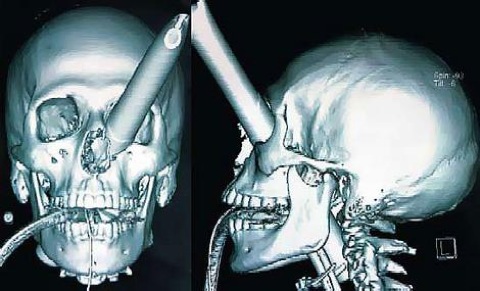
Metal chair through the face? No thanks. I said no thanks! No... Ahhhh!
Who does this remind me of....? Hmmm....
(Answer: Phineas Gage)
Was thinking about filing this under "feedback".
Tuesday, August 14, 2007

Subscribe to:
Posts (Atom)